



OCALA, FL (352today.com) – Sequels aren’t just a staple of the movie industry–sometimes they play out on a different stage, such as political theater. However, there may be striking similarities and results to the first film in the series or to a previous legislative session.
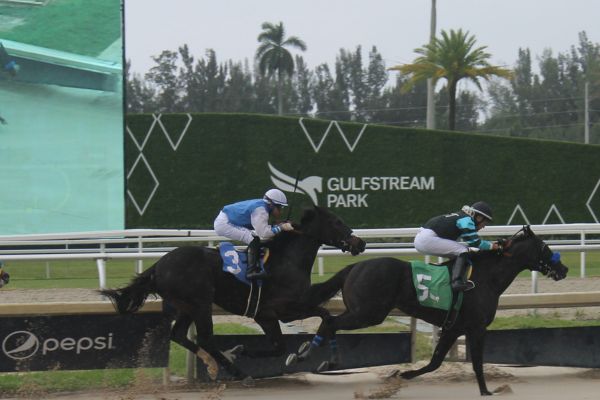
On Wednesday, Jan 14, 2026, a state legislative bill that would allow Gulfstream Park and Tampa Bay Downs to cease conducting live racing but allow them to keep their respective casino and card room gaming licenses–one remarkably similar to another introduced during last year’s session–resonated sonorously through the Florida State Capitol in Tallahassee, as the Florida State House Industries and Professional Activities subcommittee, who voted in favor of a similar decoupling bill in 2025, once more moved the decoupling bill forward Wednesday by a 10-5 margin, A similar bill has been filed in the state senate. The vote was partisan, with all of the Republicans in the subcommittee supporting the bill and the Democrats voting in opposition.
Last year, the state senate didn’t approve the decoupling measure, deciding to table it without a floor vote.
Strength in numbers
The Florida Thoroughbred Breeders and Owners Association continued its fight against HB 881 and decoupling, but also had the support of the other organizations, such as the Ocala Breeders’ Sales Company, Florida HBPA and the Tampa Bay Downs HBPA, with the FTBOA extending their reciprocity of support to the other organizations.
The road from Ocala to Tallahassee and back is one Lonny Powell, FTBOA CEO and executive vice president, has traveled hundreds of times over the past 14 years. Powell has overseen government affairs at racetracks and for different industry organizations since 1999, but the last two years have been chart toppers, bringing him to the State Capitol on a routine basis for what he described as the most unusual and bizarre sessions. It keeps life from getting boring, however, and it keeps the FTBOA laser focused.
It was an expected outcome, understanding that the Adam Anderson (R-Dist. 57) sponsored bill isn’t going to go away quietly, and that this is a matter that will continue to have a presence going forward.
Powell referred to Rep. Yvonne Hayes-Hinson (D-Dist. 21) as an all-star. In addition to Hinson, State Representatives, Ryan Chamberlin (R-Dist. 24) and J.J. Grow (R-Dist. 23), State Sen. Stan McClain, Ocala Mayor Ben Marciano, the Marion County Board of County Commissioners and Ocala Metro Chamber and Economic Partnership have all been extremely supportive, something Powell appreciates greatly.
“Rep. Hinson has courage beyond words,” said Powell. “She’s done Marion County proud, she’s in her last term, but she serves the county, the horse industry and the horse people of Marion County well.”
History and significance
The thoroughbred industry in Marion County is so much more than just its economic impact. It’s interwoven into the fabric of the area’s history, and has been for more than four generations, leaving a lasting legacy in an area known as the Horse Capital of the World.
And although there wasn’t a deep volume of speakers as the bill went before the house subcommittee on short notice, the quality and effectiveness of those who provided their testimony knew and understood the importance of the issue, providing a powerful Marion County perspective, as they’re county residents, said Powell.
“I think that the message was very clear that the Horse Capital of the World was founded upon those thoroughbred farms and now we’re a bustling equestrian center for all disciplines,” said Powell. “Thoroughbreds represent a large part of the population, one of every two horses in Marion County. It’s a large statewide business, when you look at the impact, 34,000 jobs, and a $3.2 billion economic impact. When you think about it, more than 50 percent of [Florida’s] thoroughbred industry is centered around Marion County, with the remainder being generated around the Tampa area and the Miami area in concert with the racetracks.”
Decoupling is a huge state issue, but a double-edged one, as it’s a very important state industry, one that’s responsible for many jobs, has a sizable economic impact, with a hub of economic activity, with the related agriculture and professional services, said Powell.
“The horses beginning with the thoroughbreds, we’ve had some of the greatest thoroughbreds in the history of the industry, and also some of the most amazing ones that have run beyond their pedigrees everywhere around the world,” said Powell. “It’s our culture, it’s our fabric, it’s our way of life. It’s our identity in Marion County. The only other place that I’ve lived in before that was even close to this was Lexington (Kentucky). Even if somebody didn’t directly own a horse, or even if they haven’t gone to the track or have been to a farm, they can talk a lot of horse talk. They grew up with it. They’re surrounded by it. It’s part of the culture. That’s what Marion County folks are like. You can talk about horses at some level with almost anyone in Marion County. If that’s not part of our identity, fabric or lifeblood, I don’t know what is.”
Far-reaching impact
It’s a statewide issue, and the eyes of the nation–as far as thoroughbred racing, gaming and the equine industry go–are watching closely, with Powell directing his energies toward thwarting the decoupling issue for the preponderance of his 14 years at the FTBOA. It’s a topic that Powell has discussed at great length over the years, cautioning other states to beware of similar legislation. And it doesn’t have to be pure decoupling–it can be development or anything that has to do with major live racing reductions or shifts in revenue shares.
“You have to be ready to fight the fight and have your relationships in place already instead of trying to make them on the fly,” said Powell. “This session, it’s a tight session, and things will move pretty fast. If you look at the roadmap of how things worked last year, at current times, that would be the anticipation this year.”
There will be challenges, but Powell remains optimistic. The issue has to be addressed every day. Powell brings the experience of having been the CEO of a number of industry sectors.
“I love football, I know what quarterbacks have to do, I used to play the offensive line, I never called the plays,” said Powell. “I’ve been in government relations for 27 years; I’ve never had to audible more than I have since I’ve been in Florida. Thank goodness for having such a great team of lobbyists because these lobbyists have been with us for over 30 years. We’ve always had good legal counsel. You have to be ready for this. It’s not fun, there will be twists and turns, maybe they’ll even be some good breaks. We can’t keep our head down and not assume anything. If you’re looking at a landscape and there has been no major change in players, but the core issue remains the same as a sequel it’s got a couple of other plot twists in there that might make you pause and think or because you get confused a little bit. But at the end of the day, it’s the same movie and one would typically expect the same result.”