


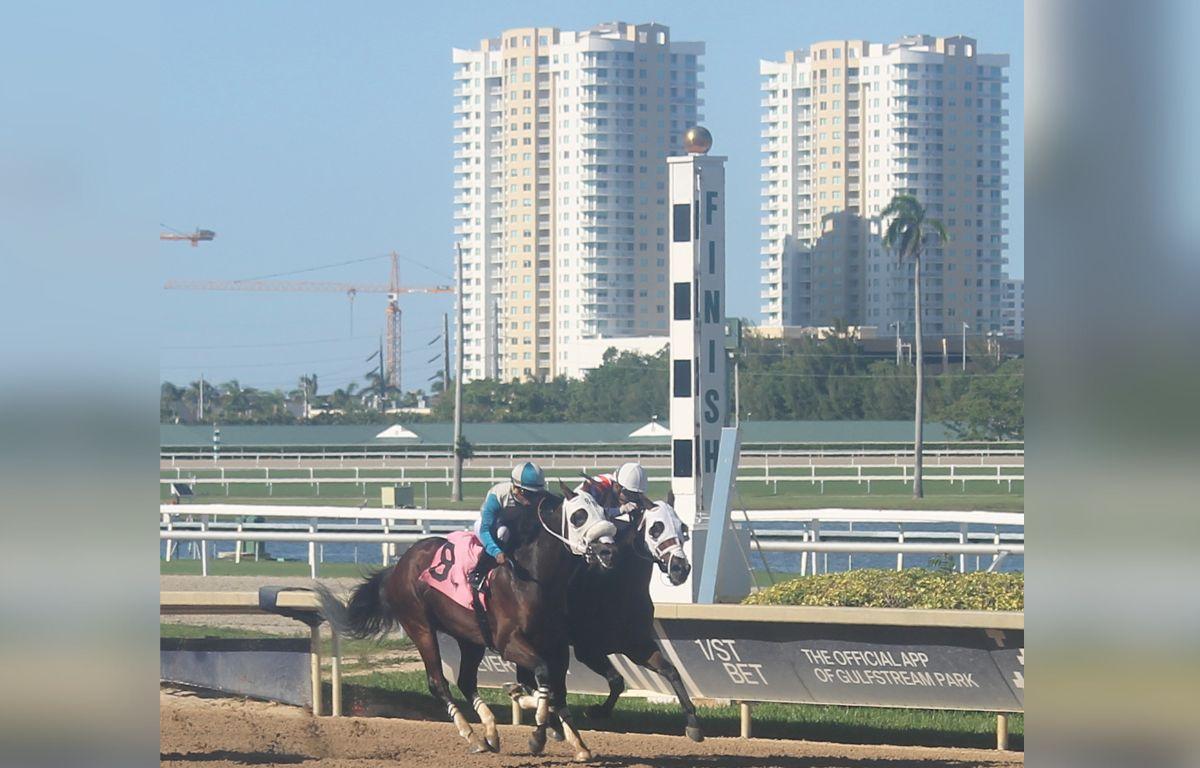

OCALA, FL (352today.com) – The idea of a Florida without thoroughbred racing could become a reality if state legislative bill HB 881 continues to move forward. The potential law would decouple the on-site casino permit from that of the live racing permit at Gulfstream Park in south Florida and the on-site cardroom permit from the live racing permit at Tampa Bay Downs, so that the tracks would no longer have to conduct live racing but would be able to keep their running their other gambling facilities. The companion bill in the senate is SB 1564.
But there is a formidable group that’s opposed to the bill, with a team that includes the Florida Thoroughbred Breeders and Owners Association, the Ocala Breeders’ Sales Company, the Florida Horsemen’s Benevolent Protective Association, the Tampa Bay Downs Horsemen’s Benevolent Protective Association and the Thoroughbred Racing Initiative.
The Florida House of Representatives bill analysis and the effect of the bill
The bill removes live racing requirements for thoroughbred permitholders and allows certain thoroughbred permitholders that do not conduct live racing to retain the ability to continue to hold and/or apply for a slot machine and/or cardroom license. The bill exempts thoroughbred permitholders with a slot machine license from certain thoroughbred horse racing purses and awards requirements and removes the authority of the Florida Gaming Control Commission to reissue escheated thoroughbred racing permits for failure of the permitholder to pay the required tax on handle for live performances.
The bill was added Thursday, Feb. 5, 2026, to the House of Representative’s special order calendar for Wednesday Feb. 11, 2026.
The second house committee meeting on the decoupling bill, which was the House Commerce Committee, took place Tuesday Feb. 3, 2026, and passed by a 15-9 vote. The bill cleared the House Industries and Professional Activities Subcommittee by a 10-5 vote on Jan. 14, 2026.
The testimony from the floor–just like during the first meeting, and the preponderance of the other stops on the issue dating back to the 2025 legislative session–came from people who opposed HB 881, which is highly unusual for a bill that has drawn so much attention nationwide, to not have the proponents stating their case, said Lonny Powell, FTBOA chief executive officer and executive vice president
The bill is totally pro-racetrack and would have a deleterious impact to the state’s thoroughbred industry, and those who are stakeholders in the industry: owners, breeders, trainers, jockeys, veterinarians, farriers, grooms, exercise riders, those work at training centers, etc., with the bill being extremely one-sided, said Powell.
“I have to compare this to the movie industry in that we saw this exact movie last year, and yet, the FTBOA and the rest of the industry watching and sometimes engaged, the FTBOA at the frontlines has seen versions of this movie for 10 plus years, and certainly the movie got very different and much buffer last session,” said Powell. “We anticipate the movie, this sequel of the movie, that’s what this session is, to have a very similar plot, a few twists and turns because it is a sequel after all, and most likely the same conclusion. When you have the same players in all the places, nothing else has changed and it’s virtually the same movie, you kind of know the ending. Last year, how this ended and it’s still very difficult to go through. It’s very tough to have this debate year after year when we’re in this industry and hear that our tracks don’t want to race and to have these discussions right over the top of the breeding season.”
Changes and revisions
HB 881 ended up evolving into a straight-up decoupling bill, with there being two strike-all action going into the bill, with substitute language being added to the bill Jan. 30, 2026, and by Monday night there was another strike-all with the language in the bill continuing to evolve, said Powell.
“The thing that allowed for a much clearer focus, even though we anticipated how the plot of the movie went last year, we anticipated a lost vote (the vote in this session’s commerce committee was 15-9), but we don’t approach things that way,” said Powell. “We have a message to get out, a record to get out. Many of the house members do care. The house vote was bipartisan, in terms of the votes in support.”
Several representatives on the commerce committee offered some solid arguments on behalf of the thoroughbred industry, with folks who were looking from the outside toward it, recognizing the significant economic impact and the number of jobs associated with the thoroughbred industry, 34,000 jobs and one that has a $3.2 billion economic impact on the state, said Powell.
“They (the arguments) were powerful, and these are all things for the record,” said Powell. “Everybody in the cyber universe, like legislative staffers, Senators, the Governor’s office, everyone is watching, and it’s so important that you put your best foot forward.”
There were five people speaking on behalf of the thoroughbred industry and in opposition of the decoupling bill at the House Commerce Committee meeting. Powell was proud of the presentations that were made by the FTBOA and those associated with the organization, FTBOA Vice President and Economist Steve Koch, FTBOA President Valerie Dailey and Powell provided testimony. Also providing testimony in opposition to the bill were Ocala Breeders’ Sales Company President Tom Ventura and Reddick-based horsewoman Lynn Boutte who represented the Florida horsemen.
Dailey, who is a breeder, owner and businesswoman, talked about the importance of live racing and what it means to certain communities statewide, and what it means not only to the racing industry but to the breeding industry as well as to all of the support industries, placing an emphasis on the significance of live thoroughbred racing and how it impacts Ocala, Tampa and Miami, and how intrinsic the horse industry is to their very fiber, said Powell.
“How it’s such a bigger deal than just talking about the industry in a narrow fashion, and how our industry has lived up to its obligation,” said Powell. “We really should be trying to strengthen it up in Tallahassee. I think she (Dailey) was spot on, and that allowed me when I was called upon to do what I’ve been doing personally for my entire career addressing what the bill really means in regular language or translating our racing parlance into what I’d like to say our plusses and minuses are in the bill, but in this bill, there were nothing but minuses, and in a nice respectful way, I felt it was incumbent upon me to walk them through that once again, that there’s no win in decoupling, that decoupling means no commitment to live racing dates, no commitment to revenue shares from gaming activities to the horse owners and trainers and the breeders. No security and no stability. In a fully coupled environment, you would be going year-to-year wondering what the track’s going to do.”
Fighting the good fight
Before the bill was presented Feb. 3, 2026, language was replaced by the last-minute strike-all, where the focus was just on decoupling, which made it much easier to address, said Powell.
In both its previous form and as it stands now the bill is ultimately a win for the tracks, and not for the horsemen and the other industry stakeholders, and there was no substantial win or benefit or reason to have hope or stability in the language as passed. However, it wasn’t a surprise to Powell or those who are in opposition to the bill because they had seen this going forward.
“I will point out, the tone in the room, the level of respect extended by both the committee members to the presenters, and we presenters and audience to the representatives, it was a very respectful, professional environment, and that’s a very good thing,” said Powell. “People are allowed to express themselves, and the fact that we weren’t held to time limits because there were only five us.”
This is far from being a quick little sprint; no matter how short the current legislative session is, the clock is running, and it’s a long-distance race, said Powell. There will be a house floor vote, and it will more than likely pass as it did last year. It will be calendared for the senate in the near future.
Last year, the decoupling bill reached a committee in the senate, but that ended up being the final stop. The work of those who are in opposition to HB 881 is far from over, but their hope is to see the bill go away as fast as possible.