


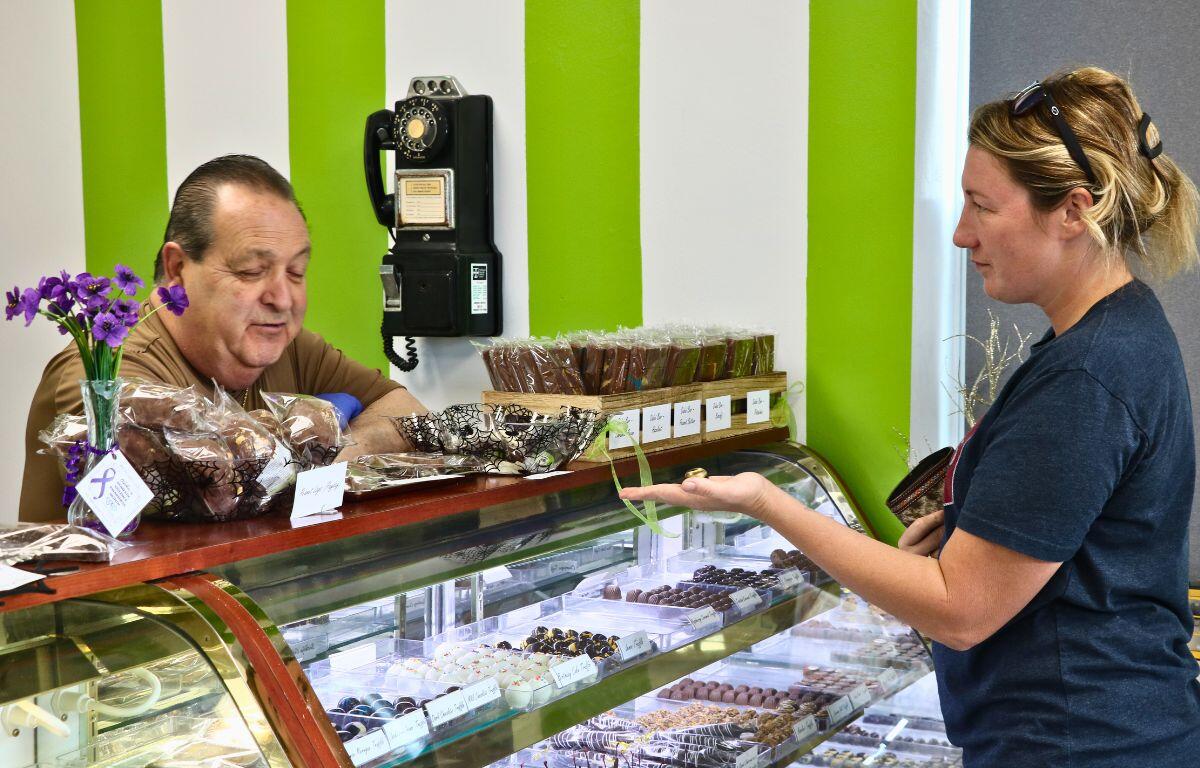

This is the third story in a 352today series on the cost of living in Marion County. The first followed a paycheck. The second followed two Ocala kitchens. This one follows the imported ingredients that end up in a Halloween bag, and on a local chocolate maker’s scale.
OCALA, FL (352Today.com) – For kids, Halloween is mostly about the candy. School-aged trick-or-treaters rarely care about the brand, the flavor, or the packaging. In a young person’s food economy, sugar is the currency, and almost any form of it will do.
There is one clear exception: chocolate. Everybody wants the chocolate. At Halloween, that preference shows up as pumpkins, skulls, ghosts, and ghoul-shaped bars and candies that feel more special than the rest of the haul.
This year, the cost of that chocolate is different.
In Williston, the owner of The Chocolate Station, John Howard, watches the numbers on the Belgian chocolate his shop imports and adjusts prices on his shop’s 65-inch electronic menu.
“Chocolate’s been raising prices probably since 2021,” Howard said. “I wouldn’t say 300 percent, but tripled in cost. If you watch the price of cocoa on the stock market, it went from as low as $23 to triple that to about $77,” he continued.
According to Howard, all of his key input costs have also risen. “Chocolate’s gone up three times. We’re importing Belgian chocolate. I mean, you’re talking premier chocolate,” he said. “So, chocolate’s made all over the world. Why Belgium, Italy, Sweden, and Switzerland? It’s because that’s where the biochemists are. So, chocolate’s grown all over South America, Ecuador, and Africa. It all gets shipped into Belgium and all those areas I just mentioned, and that’s where the biochemists really do the work, and they blend the chocolate to produce the chocolate percentages that we have. American chocolate is not done like that at all, so they do all the blending, they do all the chemistry, and then they ship it out from there.”
Howard is thankful that his customers understand that his pricing is based on real-world factors, not a bloated profit margin. He also believes in being transparent about the numbers when they rise, which is why he owns an electronic menu.
“I have an electronic menu posted on a 65-inch TV, so I can go in and change the prices, and everything gets weighed in the shop,” he said. “So you know, pretty much we have a very good handle on the price of chocolate and trying to balance the price of chocolate going up, and plus our prices here in a rural town that God has blessed us with, and people love us, and they understand. At one point, I was posting the cocoa prices just [for] people coming in because sometimes they get, you know, they get shocked by our prices, but once they taste it, they go, “Oh, now I see why.”
Howard runs The Chocolate Station alongside his wife, Maureen Jewett. They previously ran Simply Delightful Confections in Gainesville. At the Williston shop, they make their own chocolate on-site using Belgian product. “We’re the only ones that make our own chocolate locally. There’s nobody around for 200 miles. Nobody,” Howard said.
Howard typically reviews costs after Valentine’s Day and again before Thanksgiving. So, right about now.
“I always make the decision about pricing; we do it right after Valentine’s Day. That’s typically [when] a lot of chocolates are bought and sold, and the price goes up and down all through February. I usually make the adjustments after we get through Valentine’s Day, and then I won’t do it again until right around Thanksgiving; just before Thanksgiving, there’ll be a huge purchase from all the people that are producing chocolate in the months [after the] end of October, beginning of probably to the third week of November.”
Howard confirmed that due to the economy, he raised his prices this year, but he is still able to cover his costs and provide quality chocolate. “For me to import Belgian chocolate, it’s not something easy to balance. But we’ve been able to work it out where we cover our costs, and our profit margin isn’t as large, but we’d rather serve the community and do what we’re doing.”
For Howard’s regular customers and locals, he says they understand his product and pricing is based upon quality.
“People know… For us to survive and produce a product that they now all love, I have to raise prices. So yes, it’s part of the deal,” he said.
A recent customer who walked in with $30 wanted a large order of truffles. At $2.95 each and roughly three hours of work per flavored batch, that volume was not possible. The shop’s nine employees make labor the largest overall expense, but the tripling of imported chocolate is the pressure Howard manages by weighing every piece and updating the electronic menu. Specialized items such as pistachio paste from Italian suppliers have been less disrupted than bulk cocoa shipments, he noted, but overall prices for imported goods have risen.
Howard does not expect quick relief. “I don’t think it’s going to come down anytime soon unless we have some type of market change,” he said, citing wars, trans-oceanic shipping, and steady demand from chocolatiers who must buy regardless of price.
U.S. Bureau of Labor Statistics data show the broader impact. The Consumer Price Index (CPI) for candy and chewing gum stood at 229.543 in September 2026, up 7.7 percent from a year earlier, which is more than double the overall CPI increase of 3.7 percent. A September 2026 analysis in the BLS Monthly Labor Review found that from December 2019 to November 2024 the Producer Price Index for confectionery materials (cocoa products and corn sweeteners) rose 87.6 percent, while the CPI for candy and chewing gum climbed 32 percent.
The Import Price Index for sugar and confectionery product manufacturing rose 73.3 percent over the same span. Over five years ending in September, candy and gum prices were up 44 percent, compared with a 22.5 percent rise in prices for all food eaten at home. For the U.S. confectionery industry, roughly 65 percent of ingredient costs come from three inputs: cocoa beans (28.4 percent), sugar (8.7 percent), and corn syrup (28.1 percent).
At The Chocolate Station, the higher cost of imported Belgian chocolate is already showing up on the scale and the menu. The same lag is playing out across the industry, and it is not limited to chocolate. Other ingredients that travel long distances are still carrying higher costs into local kitchens this Halloween.
If you’re a fan of banana splits, higher chocolate prices aren’t the only thing making them more expensive—the banana in the middle has gone up, too
Other imported ingredients still costing more:
- Coffee has stayed elevated. The BLS coffee index was near 299 in September 2026, up about 7 percent from a year earlier. Ground roast coffee averaged $9.33 a pound.
- Fresh fruits and vegetables (including a lot of produce from South America) rose 3.7 percent over the same year. Fresh fruits were up closer to 5 percent.
- Bananas, one of the most heavily imported fruits, averaged about 66 cents a pound in September. The broader category has stayed higher even as some other grocery prices cooled.
At The Chocolate Station, the math has stayed tight. Howard and his wife still cover costs, keep the electronic menu updated, and weigh every piece so customers know what they’re paying for. Regulars understand the quality and keep coming back, even if some buy less than they used to. Military discounts help a few households stretch further. None of it changes the underlying pressure: The Belgian chocolate Howard imports has roughly tripled, labor is still the biggest expense, and he does not expect the price of cocoa to drop quickly.
He does not frame the problem as a temporary spike.
“It’s hard to say because the war [is] putting everything in a very weird predicament for the people that need it,” Howard said. “Chocolatiers around the world, we’re gonna buy it. We don’t care what the price is. We’re gonna buy it. We need it. We have to have it. So it doesn’t really affect us too much. The question is, can we resell it and make profit on it? That’s the real question.”
That question sits at the end of a longer chain. The first story in this series followed a Marion County paycheck that does not reach a basic budget. The second followed two kitchens that paycheck walks up to. This one followed the imported cocoa that still costs more to turn into the chocolate kids ask for first, and the small shops that have to decide, every season, whether they can still sell it and stay open.