


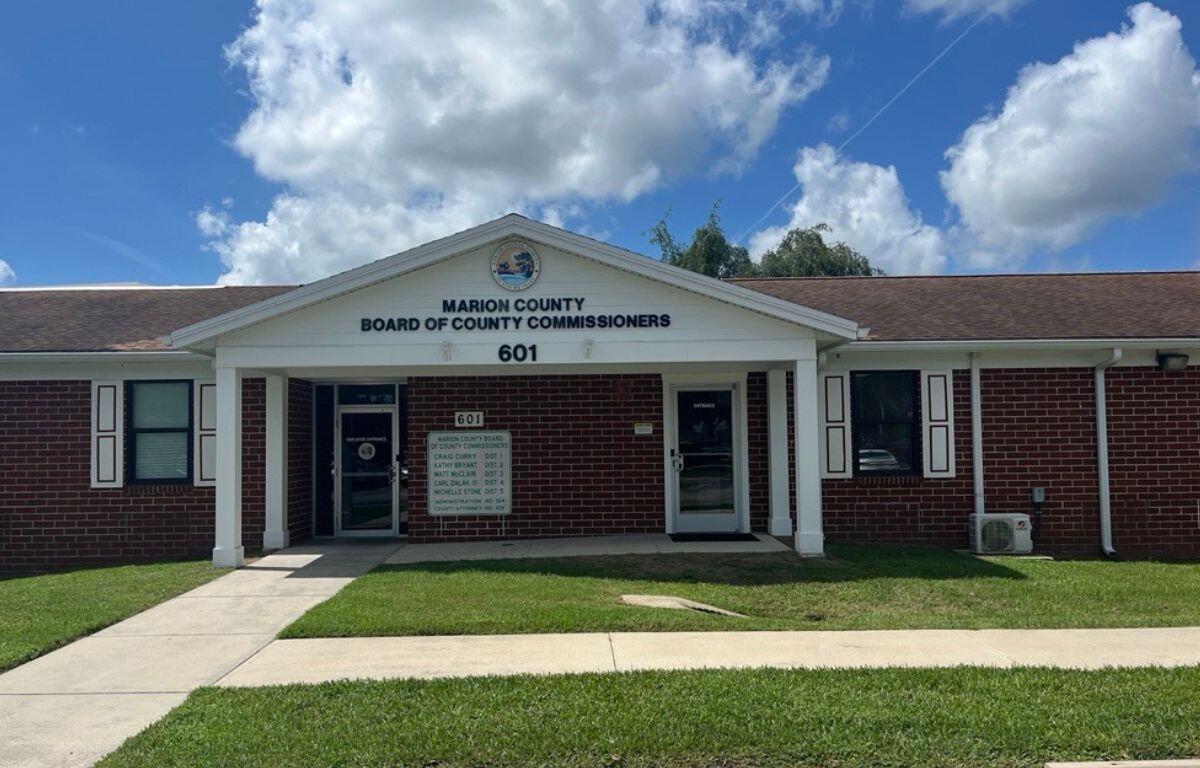

OCALA, FL (352today.com) – The first of two public hearings for the presentation and discussion of a development agreement amendment between Marion County and several developers, companies and interests related to the World Equestrian Center, was held before the Marion County Board of County Commissioners on Wednesday, Feb. 18, 2026. The board took no action and heard only public comment.
The companies represented included Golden Ocala Equestrian Land, LLC, Equestrian Operations, LLC, Roberts Development Corporation, and RLR Investments, LLC, related to Golden Ocala Development.
The second public hearing is scheduled for Wednesday, March 18, 2026, at 1:30 p.m.
There are two agreements that are on record, the initial agreement between the county and the relevant parties and a modification that was done a few years later, said Chris Rison, Marion County growth services senior planner.
For this request, Marion County staff did send out 277 public notices to the owners of properties near or potentially affected by the agreement.
The development agreement is focusing on three items at this point and time, said Rison. The first concerns the use of developments permitted, which is a reflection of that text amendment. The county is also focusing on the concert uses that up until now have been a prohibitive activity to that project site, and references to a further amendment to the agreement that would be needed within a certain timeframe, said Rison.
The concert uses are currently listed as prohibitive activities; the applicant wants to eliminate this provision from this agreement and to provide for concerts through the comprehensive plan amendment with the different facilities that are being proposed.
Regarding the planned unit development, the applicant’s newer plan is currently working through the county’s various systems, identifying locations where outdoor concert locations would be located, said Rison. Concerts could also be located indoors, within the event facility.
There was concern from Marion County Commission Chair Carl Zalak, III, that if the provisions were removed from the development agreement, it would allow the applicant to have any outdoor concert, at any time on any day.
“When we started this whole thing, they were going to do pretty much everything indoors, and then just have a few special event permits throughout the year,” said Zalak, III.
That was the change the applicant, Jimmy Gooding, Esq., Gooding & Batsel, PLLC, representing the owner, was making the request for, said Rison.
A traffic study is still being completed and finalized, but the applicant is proposing at this time, rather than holding everything in suspension, allowing them to move forward, but having that provision within six months that the applicant would pursue another amendment to their development agreement to adapt the agreement to include anything that’s identified through those studies, and update it at that point in time. The current agreement does have a number of items that relate to traffic, concurrency and improvements. There may be updates to things that have been completed on the prior list, and those may be removed at that point in time, said Rison.
“Those are the three core items of the development agreement modification.” said Rison.
The amendment addresses two issues. One is concerts, and the other is the future traffic amendment, said Gooding. This would be the second amendment to a concurrency agreement. The first one was entered into in 2018. It was based on a traffic study that Kimley-Horn had done in 2017 and dealt with a number of issues. It was the first Development of Regional Impact (DRI) level development that was approved.
“[The first amendment] required my client to do a number of things, including pay almost $6 million in proportionate share, that money has been paid to the county,” said Gooding. “It required my client to construct entrance improvements and some intersection improvements, those have been done, and others have been required at future stages, provided for my client to donate right-of-way for 80th Ave., those have already been closed, and those are the transactions that Mr. Cohoon (Steven Cohoon, Marion County engineer) had talked about that [the county] already owns, provided for impact fee credits that included some other provisions that are typically in these types of agreements, although the concert, is the first time I’ve seen one like that in here.”
In 2021, the applicant entered into the first amendment, which was in connection with the second DRI approval. It updated the first one in a number of ways including, along with dealing with the additional entitlements, requiring the owner to loan money to the county for a new fire truck, said Gooding.
According to Gooding, the concert concern didn’t come about because of noise; it was about traffic. When Kimley-Horn did their first study, they didn’t know what the World Equestrian Center was going to offer. To estimate what WEC was going to generate, and they used a racetrack as a model, where people arrive and leave all at the same time, whereas equestrian sport is a low spectator sport attraction where their arrivals and departures are staggered. However, that wouldn’t be the case for concerts, where people would be arriving and departing all at the same time.
“We agreed at that time to the prohibition on concerts, and the definition was drawn so that we could have music in connection with other events,” said Gooding. “The standalone concerts were prohibited. It was more of a function of traffic than noise.”
The applicant will be bringing a sound designer to the next meeting to talk about noise mitigation, said Gooding.
Commission Chair Zalak believes that an inordinate number of concerts on the site can significantly change the game.
“My recollection is that you guys haven’t even used the four that we’ve given you,” said Zalak. “Why can’t we keep [language regulating the number of concerts] until you max out the four and need a couple of more, work with you in that capacity and see how the community and traffic and all that stuff flows, versus, we’re done with this, ‘we don’t want the regulation at all. If we want them 365 days a year, we can have them.’ I don’t think that’s appropriate… I don’t think that ask is reasonable.”
Kittleson & Associates prepared a World Equestrian Traffic Demand Study. One facet is a parking study which was requested by the county commission, an operational analysis, demonstrating how traffic is going to move throughout the site including for concerts; the final component is the traffic study that’s still in review, said Gooding.
“We’re proposing to submit something in six months, and then go through the analysis on those, that’s what the amendment says,” said Gooding. “That will give us plenty of time to do that, and work with the county and the DOT on needed improvements.”
The traffic study has identified different segment and capacity failures. The owner is proposing proportionate share payment to resolve some of those issues. The peak times in theory won’t be occurring every day. The applicant is planning on making improvements at the intersections.
Steve Cline, attorney from the law firm of Hill Ward Henderson, represented Charlotte Weber, who is a Marion County resident, and an affected person under Chapter 163 Land Regulation Development Code, was the only one in the audience who spoke before the commission at the public hearing.
“Earlier this morning, my partners, Scott McLaren and Shane Costello, submitted a letter by email, to both the board and to the county attorneys, I’ve been told that’s part of the record, most of my client’s concern is addressed in those two letters,” said Cline. “Ultimately, we feel this is getting too far ahead of our skis. This process should slow down a little bit… It’s not just about the comprehensive plan amendments being approved in order for this plan amendment to be approved.”
Cline also brought up the fact that there’s been discussion about traffic studies that need to be done to gauge impact that concerts could have on the surrounding area. Their position is, it’s better to wait until the comprehensive plan amendments are in place, so the board and affected citizens can evaluate that it’s consistent with the comprehensive plan. It’s a requirement under chapter 163 that the traffic studies be done under the land development code and completed with the initial application for the amendments to the comprehensive plan.
“We would just ask you to review those letters and consider our client’s concerns and ultimately reschedule this hearing to occur, once those amendments, if and when they’re passed,” said Cline.
Commission Chair Zalak asked Marion County attorney Mattheew “Guy” Minter, if the county had followed Chapter 163 in response to Cline’s analysis.
“Counsel and I talked before the meeting,” said Minter. “I think he understood what we were saying as far as these things would have to be contingent on the board’s ultimate decision on the comp plan amendment. So, I’m comfortable with that.”