


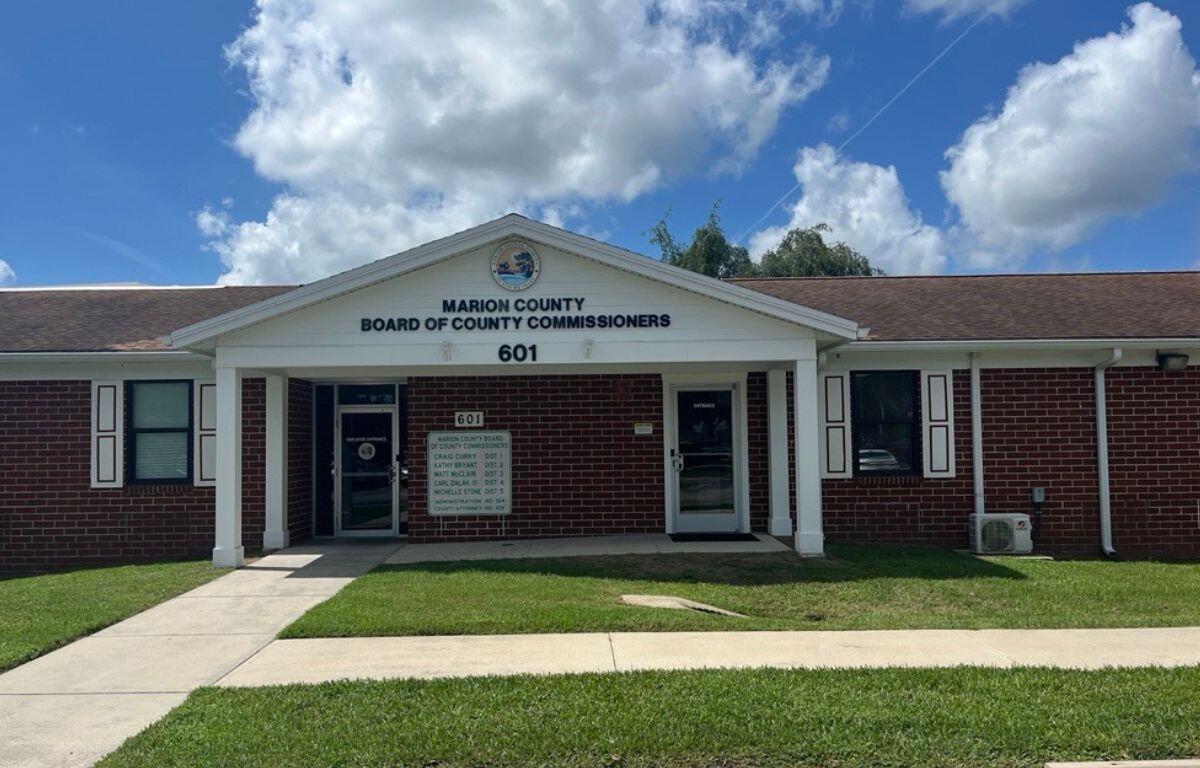

OCALA, FL (352today.com) – The Marion County Board of County Commissioners conducted a budget strategic planning workshop on Monday, Jan. 26, 2026.
And although the stock market continues to perform well, there are signs of volatility and uncertainty, probably more so than last year, said Gregory C. Harrell, Marion County Clerk of Court and Comptroller.
“The state’s property tax timeline, it is what it is, but it’s not necessarily great for our timeline purposes here or for preparing and putting this budget to rest, if any sort of referendum were to be passed,” said Harrell.
Even in a normal year, it’s prudent to start meeting in January, talking about the upcoming budget, but there are challenges, said Harrell.
“We do our best to forecast what property values will be, five, six months from now,” said Harrell. “But as you guys all know, as you’ve rotated through the chair position, you’ve seen how things crystallize the closer we get with better information from the property appraiser and tax collector’s office as to where we’re going to stand. So, with all that being said, as far as the clerk is concerned, I will be coming to you with our budget, and I think it’s going to have to be a very conservative approach this year, if any increases, modest increases. I don’t see my office asking for any additional positions or any big substantive increase in the way of software or hardware. At most, we’d probably be looking at a COLA (cost of living adjustment). I think that the information before you suggests that the CPI (cost performance index) is around 2.7 this year, and that’s something that we’ll certainly be mindful of.”
The other big challenge for the Marion County Board of County of Commissioners will be the use of non-recurring funds from last year’s cycle versus recurring expenditures, said Harrell.
“It’s going to be sort of a tighten the belt kind of year,” said Harrell.
Balancing act
The office of the county administrator provided the board with an update on three items, the first being property management, said Mounir Bouyounes, Marion County county administrator.
“Last year, when we had the discussion about property management and I was questioning where that work unit was placed at, which presently it’s at OCE (the Office of the County Engineer), but that unit provides services of right-of-way acquisition, imminent domain, property appraisals and mostly focusing on right-of-way acquisition,” said Bouyounes. “We have one position in that unit funded by the general fund that handles all the leases, all the other property needs for all the other departments.”
After an evaluation by Marion County staff, they recommended that the work unit be kept at OCE, but a closer look at the upcoming budget at the staffing level will determine whether there is enough staff in place to cover all the general fund, and all the other departments needs and the work that they’re asking this unit to do, said Bouyounes.
“We’re also talking about renaming that work unit to be more representative to the work they do, and to create some SOPs (standard operating procedures) that will be administratively done, so it’s clear for every department what to expect from that work unit, and one thing new, is to allow internal billing. For example, when this unit is doing work for solid waste, utilities or fire, then they will be able to bill, and the revenue will go into the general fund to offset some of the cost. That’s where we’re at with that unit, and my recommendation is to keep it at OCE and evaluate those items I just mentioned as we go through the budget.”
Staffing needs
Also brought to Bouyounes’ attention last year during the budget workshop and discussion were the parks, airport and Southeastern Livestock Pavilion. Bouyounes asked Assistant County Administrator Angel Roussel and Marion County Parks and Recreation Director and Landscape Architect Jim Couillard to look at that arrangement and provide their recommendation as to whether or not the arrangement should continue or if changes need to be made.
‘There is a huge benefit of keeping the airport and livestock pavilion under parks and recreation,” said Bouyounes. ‘There is a benefit of economy and administratively, we have staff in parks that can assist the other two units.”
Currently, there are 10 FDEs (Florida Recreation Assistance Development Programs) in parks, that they do assist those other two operations, and there’s one FDE in SELP (Southeastern Livestock Pavilion) that’s part of that group to do all of the administrative and project type accommodation. The workload has increased since that time, and the recommendation is to keep the arrangement the way it is, and to see if it’s possible to augment with FDE the project management as that would alleviate the pressure that administratively is currently being felt by parks and recreation, which isn’t staff assistant type work, said Bouyounes.
“That’s something that I want to examine through the budget was parks, to see what the staffing need is to be able to provide those services,” said Bouyounes.
Commissioner Kathy Bryant asked why there isn’t a position under growth management that would address those needs. Bryant also raised the question would it be more appropriate for it to be funded out of planning and zoning.
“That’s another option,” said Bouyounes. “That was not recommended. That department already has a landscape architect on staff. They deal with those types of projects. If we augment that unit with the FDEs necessary to do the work. I think you would have the expertise in that department to do that type of work. But if it’s the board’s direction to add that position in planning and zoning, that’s something we will look at in the budget.”
No matter what happens, when someone comes in with a development, if the county has these people on, the building permit or the developer permit, or whatever that permit is, the fees cover the service cost, said Carl Zalak, III, Marion County Commission chair.
Every unit in the review process for permitting charges fees, said Bouyounes. However, there are questions as to whether or not the fees are able to cover all of the costs.
“We try to recoup as much of the cost as possible,” said Bouyounes.
Responsibility and resilience
The workload that parks and recreation is carrying right now through development review is on the director and one person in the director’s office who is the director’s designee, said Couillard. The designee does all the plan review, all the field visits, and her original job title is project assistant.
“Her job is to help us manage our capital improvement projects, and our small jobs in the field,” said Couillard. “We do a lot of tremendous small projects, playground replacement, sidewalk updates, all those little things are designed and managed internally.”
However, the preponderance of the designee’s time has them reviewing plans and calling and meeting with consultants, putting the work back on Joey Amodo, Marion County parks designer and Couillard, said Couillard. Amodo is currently running about $10 to $15 million capital improvement projects, while he’s in the process of trying to get his landscape architectural license and balancing all of the projects within the department without any help.
“Whether you hire a different landscape architect to go work in growth services to perform the work that I do, or if you just simply move positions that’s fine, but from a customer service perspective having design review in a one stop station is better than bouncing them from office to office to go get permits from here and there. That’s my personal perception on it, just from being in it for a while, when people say you have to go to parks to talk about landscaping that raises some questions in some consultants’ minds, ‘I’m already at growth services or I’m at OCE.’ We’re shuttling people around. How it gets funded, that’s obviously a topic, but where is the workload, that’s the main point for me.”