


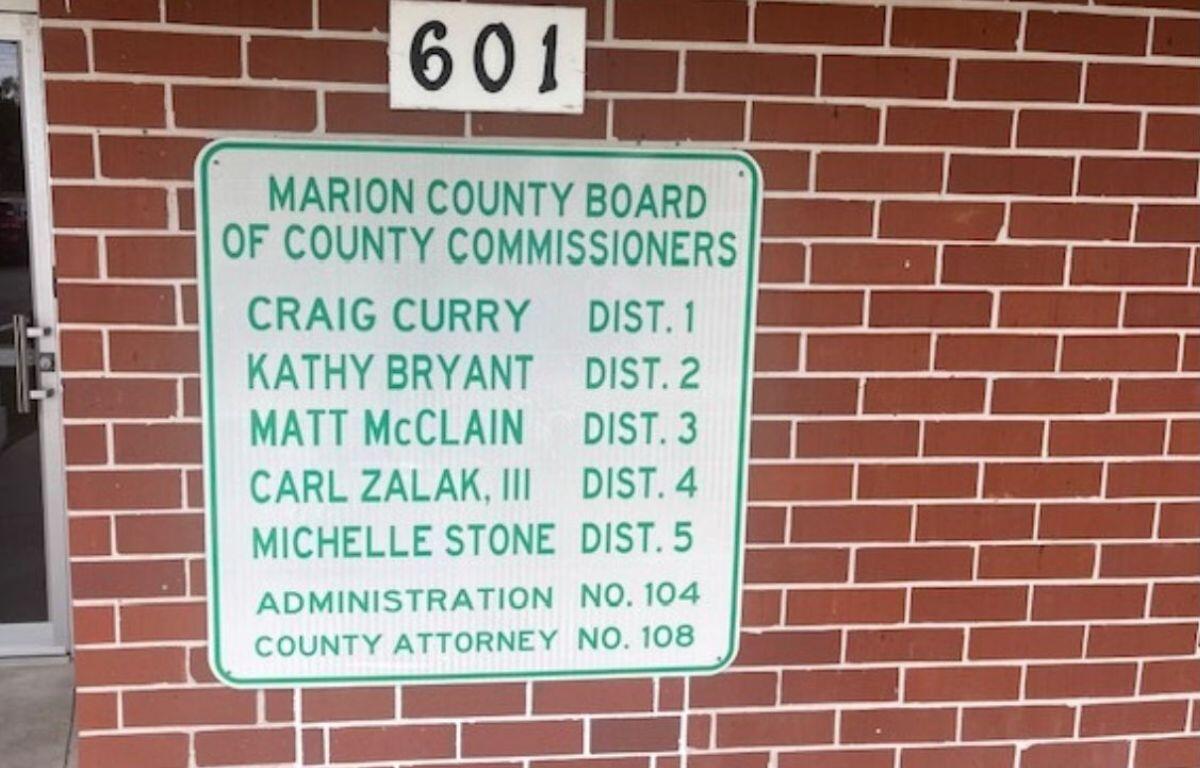

OCALA, FL (352today.com) – Wastewater services in the southwestern region were the main topic provided during an update presentation at the Marion County Board of County Commissioners workshop on Dec. 2, 2025.
Marion County Utilities Director Tony Cunningham led the presentation team. Marion County started a project years ago which took an in-depth look at wastewater service in county’s southwestern region. The county’s partner in the project is civil engineering and infrastructure consultation company Ardurra; Mitchell Chauncey, Kathryn Stephens, Dave Rasmussen and Chuck Pigeon, who are part of the consultant’s team, shared their input during the meeting.
The main driver for the project is capacity, with regard to projections of population and flow considering the exponential growth that the area has been experiencing.
Effluent disposals were also discussed during the update. Part of the wastewater treatment process is separating solids from liquid, and processing that liquid into beneficial reclaimed water, along with disposal of waste. There was also an update on the Capital Improvement Plan and the capital budget, and how the department is planning for the project.
Long history
Chuck Pigeon, Ardurra Consulting Group, Inc., principal engineer, has vast knowledge of the area, and was there when originally preparing the Development of Regional Impact for the Oak Run Water Treatment Plant.
The expansion of the current facility took place in 2010. The county purchased the facility in 2004, designed the expansion in 2009 and went online the following year. In 2016, the county spent several million dollars putting in odor control, bioreactors, filters and covers, significantly reducing odor generation.
Strain and stress
As the population, water use and flow increase, it’s harder to upgrade and maintain that facility. On paper, it’s about 70 percent utilized capacity-wise, which technically means that you don’t want to get much further than that because it gets very difficult for the operators to keep the process, said Pigeon.
“It’s a biological process. You have to keep the bugs happy, you have to keep the oxygen levels just right, you have to keep the fluids transferred, it’s a process, it’s not simple science. It’s keeping a healthy biology going between hurricanes, rainstorms, cold, hot, it’s changing constantly,” he said.
“We have to help the operators to manage that properly. The end result of that is having a good quality effluent coming out of your plant. It has been for a long time. They’ve done a great job.”
Making the right decisions
Ardurra has done several due diligence engineering studies on the county’s behalf, so proper decisions can be made, and they’ll have the proper information, said Pigeon.
The first big review in that region was the Marion Oaks Wastewater study in 2016 because Marion Oaks was growing. The first study looked at the 26,000 lots in Marion Oaks, its development and its growth, and building a treatment plan where the old Marion Oaks wastewater treatment plant was, using effluent disposal on golf courses and greenways, said Pigeon.
“We stepped back and then the county directors said, ‘What’s happening at Oak Run?’ They’re pretty close together, every time you have to operate a plant, you have all the people, equipment and staffing and manpower, and multiple plants cost a lot of money. Can we consolidate this?’,” said Pigeon. “They went and had us do a study on the capacity needs for Oak Run, which is sort of the next step, and with that study in 2019, that set the stage for Oak Run’s growth and Marion Oaks’ growth. What can we do to have a consolidated Southwest District, and what’s the best economy to manage and operate that?”
There are also logistical challenges, as the nation is still facing a shortage of operators, something that’s not just endemic to Marion County or Florida.
Focus on the future
The county commissioned and selected Ardurra to conduct a large-scale comprehensive study of all of the alternatives for the southwest area, which was completed in January 2024.
“We did a supplemental conceptual design study early in 2024, which basically set the stage for the alternatives where it needed to be, what the most economical location was, how it can service your existing infrastructure because you have a lot of existing infrastructure that goes to Oak Run and that area,” said Pigeon. “It’s not just the plant but the stuff around it, and then the growth.”
The last thing the consultant has done this past year, was composing three technical memos, with one of them addressing odor control, another addressing the biosolids and how to handle the solids’ part that comes out of the plant with dewatering, processing and delivery, and the last one was how to look at the future, long-range, 20 years, 30 years, 50 years from now at build-out, said Pigeon. For this area the county would need about 20 million gallons capacity. Currently, the county is at 1.6 million.
“If everything was to build out on SR 200, Marion Oaks, that region which is 130,000 acres of the study area, about 160,000 people, when built out based on today’s zoning, would be about 20 million gallons per day,” said Pigeon. “It may be 100 years from now, but you have to keep that in sight, let’s not plan for two years, 10 years, 20 years, the real planning horizon should be for 30 years. That’s what the funding agencies like to see.”
Reaching the limit
Currently, the flows at the plant are at 1.1 million out of a theoretical 1.6 million. Based on the projections and what the consultant looked at as a realistic projection, realistically because of the population demographics, the size and number of houses, the area is at about 100 gallons per household per day, which is about half of what the county’s comprehensive plan requires the county to design for. If the county were to design for today’s code, the county would be out of capacity for the area. If the county were to design for the code for the next 30 years, a 4-million-gallon treatment plant would be necessary, said Pigeon.
“There’s realistic numbers and then there’s code numbers,” said Pigeon. “Realistically, we felt that was the best recommendation because the characteristics of the population are not going to change radically. It gets bigger but it doesn’t change how much wastewater they’ll generate without a radical change in demographics. That’s not Marion County. Realistically, you have about three years left of capacity in your treatment plant,” said Pigeon. “Rerating and doing other things may squeeze another year or two out of it. That’s not a lot of time. Three years ago, we were saying, you really need to have something done in three or four years, and now we’re in year three, and we’re saying maybe you have three years left, and then it’s going to get pretty difficult.”