


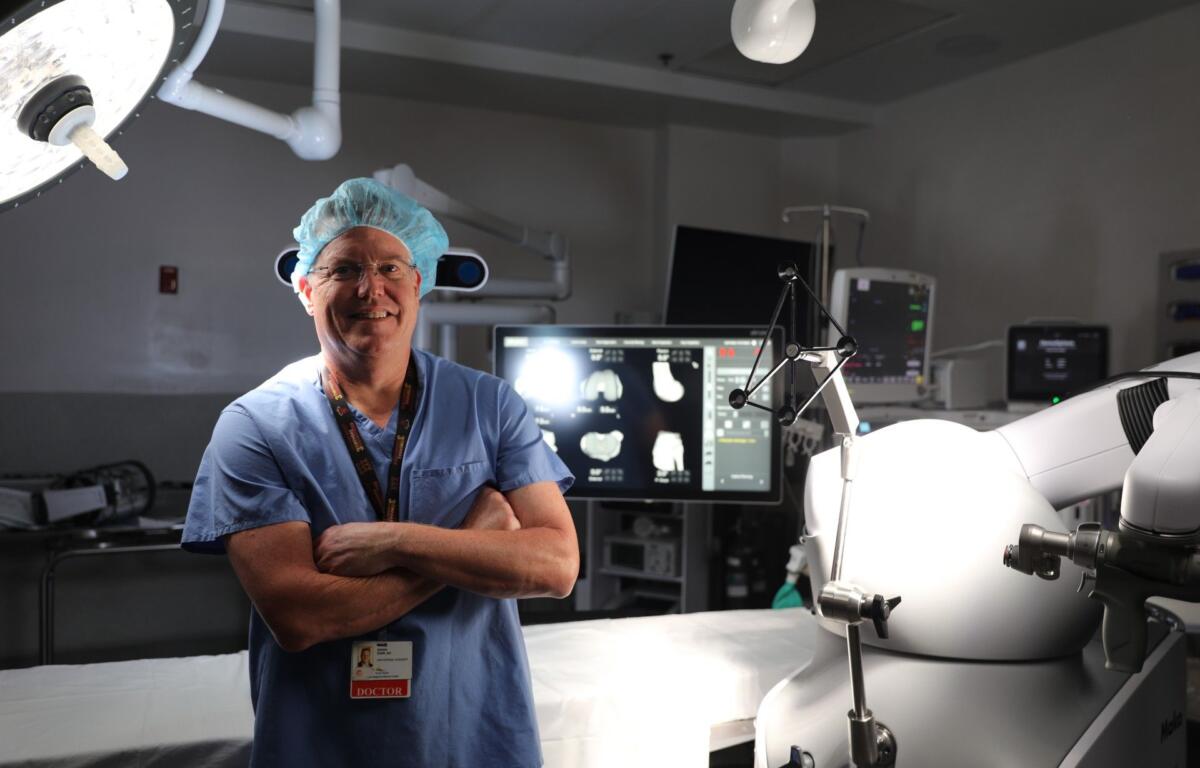

MARION COUNTY, FL (352today.com) – HCA Florida Ocala Hospital and HCA Florida West Marion Hospital are now offering total knee, partial knee and total hip replacement surgeries using the latest generation of an advanced robotic system that provides better outcomes and reduced impact on surrounding tissue. This advanced surgical tool transforms the way joint replacements are performed by helping surgeons know more about their patients before surgery and make smaller incisions during the procedure.
The new device offers 3D CT-based planning coupled with state-of-the-art haptic technology that provides surgeons auditory, visual, and tactile cues that help them remain within planned boundaries for bone preparation and implant placement. The hospitals’ surgeons use this unified system to create for patients a personalized surgical plan and identify the desired size, orientation, and alignment of the implant. This results in better outcomes like less pain and quicker recovery times compared to manual surgery.
“With this robot, I can utilize a CT scan to create a personalized surgical plan based on each patient’s unique anatomy before entering the operating room. During surgery, I can confirm my plan and make any necessary adjustments while guiding the robotic arm to execute the intended surgical plan,” said Dr. Derek Farr, DO, an orthopedic surgeon with HCA Florida Ocala Hospital and HCA Florida West Marion Hospital. “It’s exciting to be able to offer this transformative technology across the joint replacement service line. It’s all about getting patients back on their feet and back to the activities they love with less recovery time and pain.”
Total knee replacements in the United States are expected to increase 85% between 2020 and 2030, yet studies have shown that approximately 20 percent of patients are dissatisfied after conventional surgery. HCA Florida Ocala Hospital and HCA Florida West Marion Hospital’s new robotic surgical platform combines advanced robotic technology with a clinically successful knee replacement mechanism that enables physicians to operate with more predictability, precision, and accuracy in comparison to manual procedures.
The partial knee replacement treatment option is designed to relieve the pain caused by joint degeneration due to osteoarthritis that has not yet progressed to all three compartments of the knee. By selectively targeting only the part of the knee damaged by osteoarthritis, surgeons can resurface the diseased portion of the knee while helping to protect the healthy bone surrounding the knee joint. Studies have shown that robotic arm-assisted partial knee replacement increases accuracy of implant position compared to manual partial knee replacement procedures.
Additionally, by 2030, total hip replacements are projected to increase nationally by 71 percent. The new robotic surgical system available at HCA Florida Ocala Hospital and HCA Florida West Marion Hospital offers a total hip replacement option for adults who suffer from degenerative joint disease of the hip. During the procedure, the surgeon guides the robotic arm during bone preparation to prepare the hip socket and position the implant according to the predetermined surgical plan. A recent study indicates the new surgical device provided greater bone preservation compared to manual surgery.
“We are excited to offer our community this highly advanced surgical technology at HCA Florida Ocala Hospital and HCA Florida West Marion Hospital,” said Alan Keesee, chief executive officer of HCA Florida Ocala Hospital and HCA Florida West Marion Hospital. “The addition of this equipment to our orthopedic-surgery service line further demonstrates our commitment to provide the Ocala/Marion County area with outstanding healthcare.”