


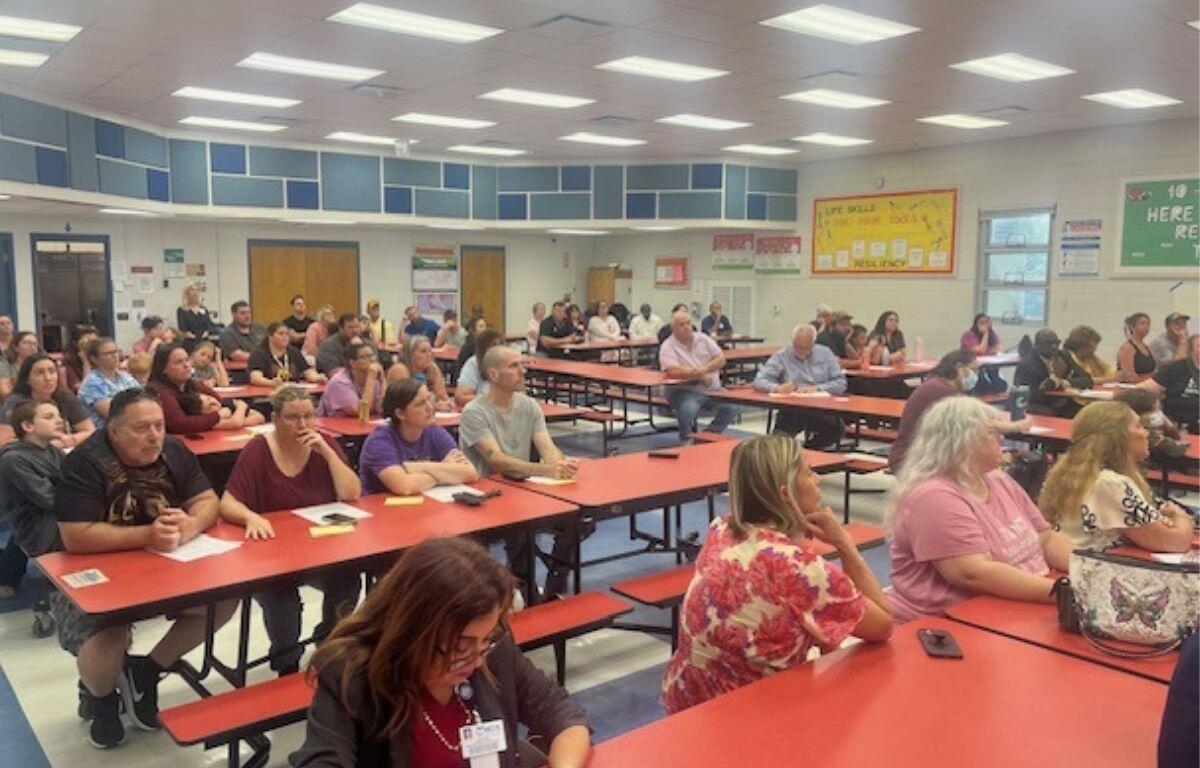

SPARR, FL (352today.com) – There are questions in relation to rezoning and consolidation weighing heavily on the minds of parents, students and staff at schools in Marion County’s Northend, and a Marion County Public School community input meeting was held Monday, March 9, 2026, at Sparr Elementary School to address some of those questions.
The school district is tasked with the responsibility of having to make informed decisions on how the schools are operated on the Northend. There are no easy answers, and there’s no simple way that’s going to make everyone happy. However, it’s critical to gather community input when considering what the future may look like, said Ben Whitehouse, MCPS deputy superintendent.
There will be additional community input meetings on Wednesday, March 25 at Reddick-Collier and Thursday, March 26, 2026, at Anthony Elementary, both beginning at 5:30 p.m.
MCPS staff came back to the school board with a proposal early last fall, looking three years into the future, including the possibility of closing down Anthony Elementary School and building a combined school on the Sparr property.
“There is property behind the school that we own,” said Whitehouse. “It has enough space for us to put the footprint of a new campus or add additional wings to expand the capacity of Sparr Elementary, and to be able to bring students from Anthony here. That is one option, but it’s not the only option that could possibly be out there on the table. That’s what we have shared as our recommendation, [with] the timeline for construction being 2028.”
Conversations at a prior work session accelerated some of that discussion, looking at the possibility of closing down for the next school year. But at the last work session that discussion was tabled, taking 2026-2027 off the schedule. There will be a great deal of discussion regarding the 2027-2028 school year going forward, however, regarding creating some good and useful space for the Northend communities. That’s also fiscally responsible for the school district to be able to continue to operate and is healthy and sustainable as a school system for all of the students in Marion County going forward, said Whitehouse.
No schools will be closing in the Northend for the 2026-2027 school year.
MCPS staff answered the questions of concerned parents who attended Monday’s meeting, welcoming the community input and feedback. There’s also a community input forum online.
The question was asked, why isn’t Fessenden Elementary being rezoned, when they’re over capacity? All options are currently on the table, said Stephen Ayers, MCPS director of student assignments and records.
“The key thing that I want you to look at, when I look at these maps, is look at where the students are located,” said Ayers. “It’s not as easy as just saying rezone it because all of the students are so congregated in a small area. Rezoning is very difficult. We want to honor neighborhoods and honor the schools.”
The school district has put a lot of money into programs in Reddick, and they’ve made a difference in attendance, said Ayers.
“But just because a program is successful at one school, it doesn’t mean it can’t be successful at another school,” said Ayers. “So, whatever programming is in place, we can also have those programs in other schools. The programming will not go away.”
Reddick-Collier Elementary is only 7.2 miles away from Sparr Elementary. The time that children spend on a bus is always a valuable consideration, said Ayers. The school district not only has to account for the students’ time on a bus, but also the fuel. The school district takes into account those variables to make things efficient as possible. Time on a bus is a huge factor when rezoning is taken into consideration.
Cost and consideration
If a school is closed, it will be closed to rebuild something, said Ayres. Schools can be combined. Reddick-Collier is almost three times the capacity of Sparr. All of the students at Sparr could fill that campus, and if the school district is trying to be fiscally responsible, that’s one of the options. Nothing has been decided at this time.
Anthony Elementary is only 8.35 acres compared to the 23 acres at Sparr Elementary. The school district has the room to build a new facility at Sparr Elementary, but any type of rezoning would have to accommodate having wings built or the existing structures being remodeled for the new school building, so it wouldn’t be closing the school and walking away, said Ayers.
The question regarding why the MCPS board was not going by the recommendation of the committee that the board formed to move Anthony to Sparr was raised, but there were multiple reasons, with some being fiscally based, while others included not having enough input to go forward with that decision, said Ayers.
Building 10 at Reddick-Collier remains on the FISH, Florida Inventory of School Houses, report because it’s still suitable to take children, but it’s not the best option, said Ayers. The building would have to be renovated.
Another of the questions asked was regarding school choice, about the kids who were enrolled at Sparr Elementary and what would happen to them.
“If the campus moves, the programs would move with that campus,” said Ayers. “If the campus was moved to another campus those kids would follow in that program and stay in that program. School choice is always going to be an option.”
Ideally, the school district wants the capacity of the school to be about 80 percent of maximum, and the reason for that is that it allows for future growth, said Whitehouse.
“When we see campuses that are already at 100 percent, it makes us a little nervous because as new communities are built, and new people move into that area, we have to scramble to figure out what do we do, do we rezone, do we add portables?” said Whitehouse. “So, if we can have a little bit of wiggle room within our capacity, we can still operate officially within that school but still have room for future growth. Right now, if you look at our campuses, we have Sparr that’s operating over 100 percent, we have Anthony that’s operating at about 75 percent, a little under target, we have Reddick that’s operating well under 50 percent, so they’re way under target. Even if we were to eliminate Building 10, which pulls about 150 student stations out of their overall capacity, they would still be barely at 50 percent with their capacity.”
There was also a question about Reddick’s water, and what is being done to resolve that issue. The school district takes water safety seriously at all of their campuses, said Whitehouse.
“There is no plan for a large expenditure for water at Reddick,” said Whitehouse. “We test all of our water every year to make sure that our water is acceptable to drink for all of our students every year. If there’s ever a point that it’s not, we quickly shift to bottled water before we allow students and staff to go back to utilizing that water.”