


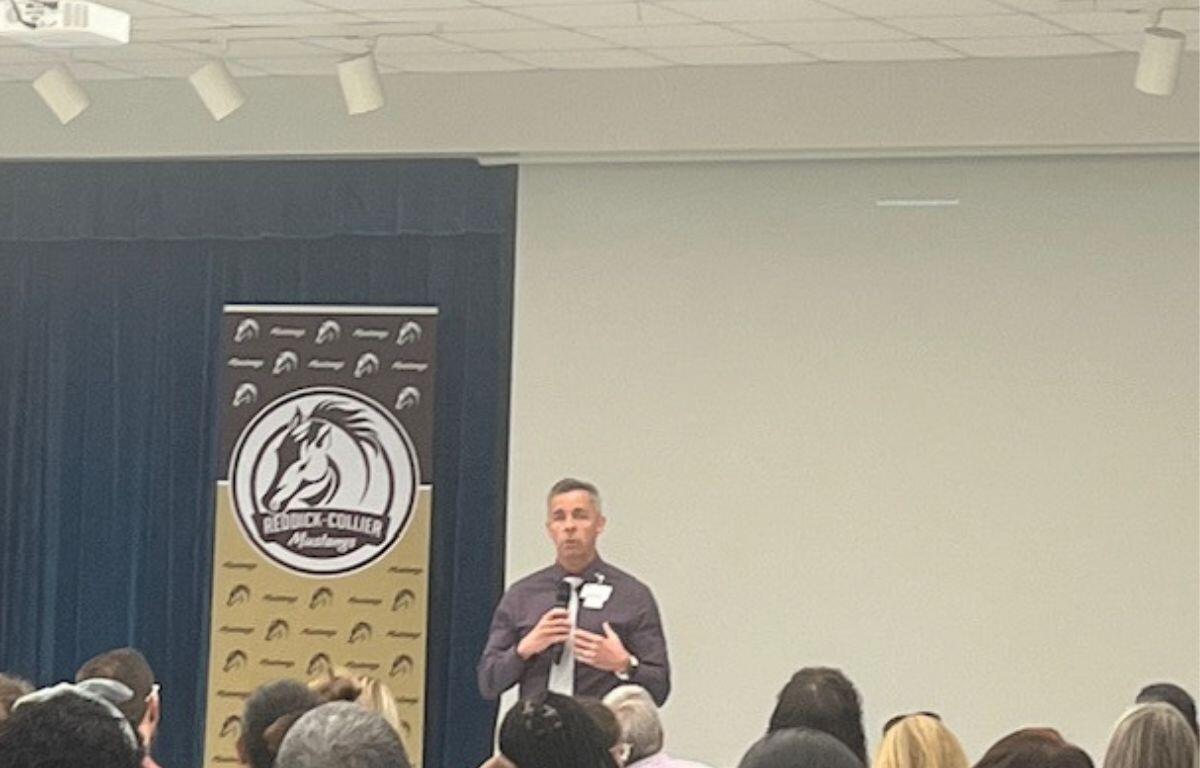

REDDICK, FL (352today.com) – The second of three Marion County Public Schools Northend community meetings was held Wednesday, March 25, 2026, at Reddick-Collier Elementary School to gather input and answer questions regarding rezoning and consolidation.
The school district is setting itself up for future success financially. A lot of school districts are facing financial challenges. Alachua County just closed three schools for the next school year. Orange County is closing seven; multiple school closures are taking place in close proximity to Marion County, said Ben Whitehouse, Marion County Public Schools deputy superintendent.
The school district’s goal is to avoid getting into that situation, said Whitehouse. MCPS wants to be ahead of the game, making sound decisions and preparing the district for the future. At the present time it appears that the school district is in a good place, and the school district is taking pains to retain that status moving forward. However, proactive steps need to be taken by the school district to go in that direction and get into a better position for the future, he said.
Transportation remains a major variable in the equation, in terms of fiscal responsibility, considering where it’s most economical to transport those students, said Stephen Ayres, Marion County director of school choice and student records.
Rezoning is one option that the school district looks at whenever they’re underutilizing or overutilizing campuses, said Whitehouse. The school district just did a rezoning for a new high school, and they’ve done rezonings in the past to balance enrollments. Rezoning is the quickest and easiest way to balance student enrollment. It’s not always the best solution but compared to trying to build wings for a $15 or $20 million campus or building an entire new campus, moving students around and changing attendance size, is the less expensive and a faster way to accomplish those objectives.
Regarding schools in the Northend of Marion County, if one were to combine all of the capacity available of those schools and student enrollment it’s just under 80 percent, and MCPS wants to get them a little bit more utilized than that, said Whitehouse. Ideally with schools, especially in a place where growth is happening, the school district would want the utilization to be above 80 percent and still allow some room for growth. There’s not as much growth projected for the far north, but that changes when you get closer to Ocala Springs Elementary School and toward the central part of the northern area of Marion County. Currently, Ocala Springs is far over capacity.
“A lot of the growth capacity in the Northend is dictated by two things, the comprehensive use plan that Marion County has, that the school district doesn’t control and the Farmland Preservation Act. That limits the density of the growth, and that’s why you don’t see the high growth, and that’s a good thing because people live on a farm for a reason and that is by design,” said Ayres. “Fessenden is almost at maximum capacity.”
There were questions about school choice, where the student’s parent is responsible for transportation. The only way rezoning will affect school choice is if a school reaches more than 90 percent capacity. If a student is currently at a school with school choice and something happens with the rezoning, you would stay with that school and move with those students.
There will be no rezoning taking place for next school year, the 2026-2027 school year. The school district is looking for potential solutions for the Northend schools for the 2027-2028 school year and the future.
“We’re going to make sure that we gather as much information as we can,” said Whitehouse. “We have a very thoughtful process for deciding what this needs to look like as a Northend solution for not this coming school year, but the following school year or beyond depending on what decision the school district makes. “
One of the advantages of combining campuses and having larger campuses concerns the district’s ability to provide better services to the students because of the concentrated student populations in one area. If you combine student populations together, the school district can also combine their support efforts into one location allowing the school district to better support those students, providing more and better resources in a concentrated area, said Whitehouse.
For this coming year, the school district has switched to site-based budgeting for their schools, which means that the principals have the funds available to them that their students generate–every student generates funds from the state funding formula, and they’re able to make financial decisions that are best for their school based on the existing population. The more students a school has, the more funds it has available, meaning better financial decisions can be made to support those students.
The obvious downside to rezoning is that nobody wants to leave their school. No one likes change. Some students are going to have to change and are going to have to move to another school, and on the Northend the schools have been around for a long time, where generations of families have attended the same schools, and changing schools is a difficult process for many. The other thing that the school district looks at is transportation in terms of how long the student will be riding by bus or car; the amount of time a student spends on a bus can be a potential downside.