


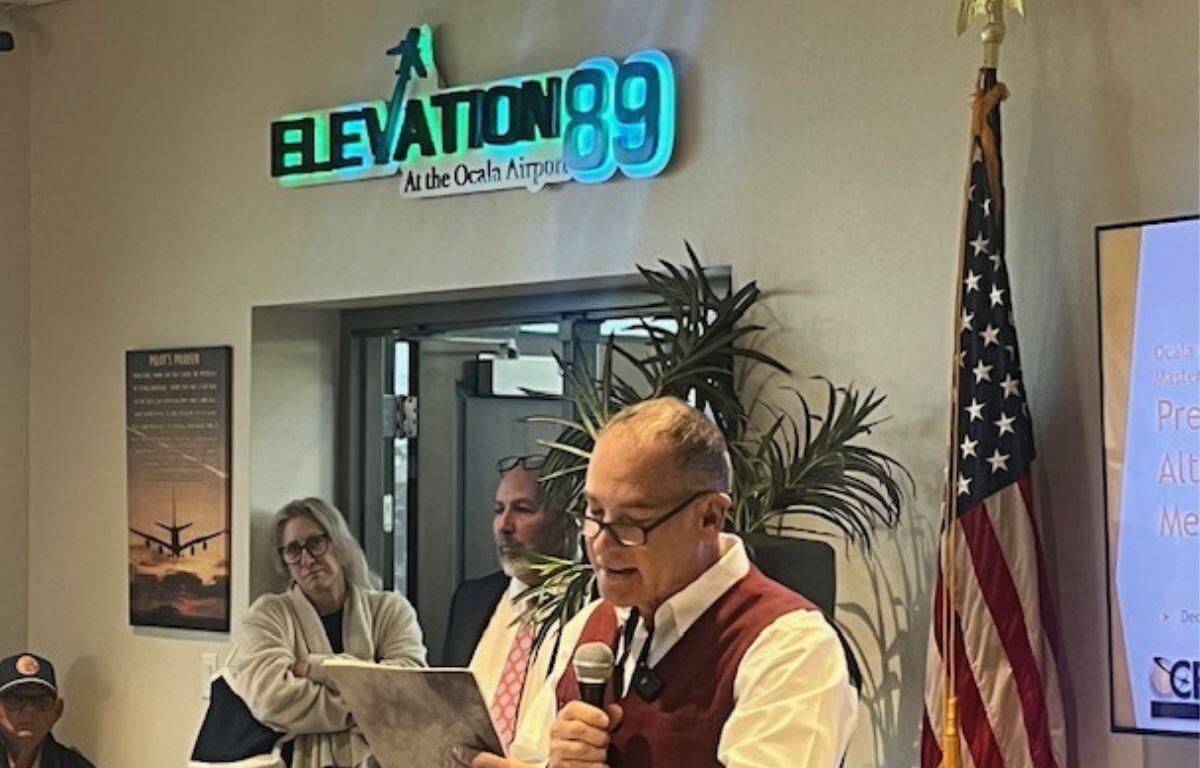

OCALA, FL (352today.com) – An Ocala International Airport Master Plan presentation gave citizens insight into the facility’s long-term vision at a meeting on Tuesday, Dec. 9, 2025, at the airport’s restaurant Elevation 89.
The crowd was standing room only, with those who couldn’t fit in Elevation 89 able to watch the presentation in the airport’s terminal lobby.
Ocala City Councilman Barry Mansfield and Marion County Public School Board Member Nancy Thrower were the elected officials in attendance. Several of the Ocala International Airport board members were also present during the presentation.
Matt Grow, airport director, has been at Ocala International for 21 years, and this is his third master plan at the airport.
This year’s master plan was funded primarily through a Federal Aviation Administration grant, with the Florida Department of Transportation also participating, said Grow. The total cost of the project was $932,000, with the FAA contributing $838,000, the FDOT chipping in $74,000, and the airport matching a total of $18,600. The Ocala International Airport is a general aviation airport that’s self-sufficient and doesn’t rely on the taxpayers. The airport keeps the money that they earn, and it goes back into the infrastructure for the operations in the airport.
“We appreciate those partners in funding this plan,” said Grow.
Forecasting the future
The FAA recommends that an airport master plan be conducted about once every 10 years, or after significant changes or improvements to the facility. The Ocala airport meets both of those criteria, said Grow. The last master plan occurred about a decade ago.
Since the completion of that update, the airport added a new general aviation terminal, private hangar development increased dramatically, and increased total based aircraft to almost 200, including 20 jets. Several non-aviation properties were sold, and many other properties have been released by the FAA for future sales, said Grow. The airport is also affected by the opening of the World Equestrian Center, growth of the industrial parks along the I-75 corridor and an influx of new residents. When combined, these factors influence the elements that are essential to the identification of the capital improvements necessary to maintain the airport and sustain its financial self-sufficiency.
The Dec. 9 meeting addressed how and when to build the infrastructure to support the growth of the airport in the future.
Many of the people in the crowd wanted to know about the possibility of commercial service in the future, while others were concerned about factors such as noise and how it may affect the county’s character. However, the focus of the meeting on Dec. 9 wasn’t intended to identify the path to making commercial service a reality.
It will take a combined effort between the city, the county and the business community to move in the right direction to identify the projects and the improvements necessary to support that type of an operation, said Grow.
The airfield in its present state can accommodate domestic service, but it doesn’t have the vertical facilities at the moment, said Grow. The improvements that will go in, will go toward making that a realistically viable option. However, there are many other factors involved, and the master plan doesn’t address such relevant variables as pilot shortages, aircraft issues, the competition of airlines and the overall marketplace.
The consultant discussed the master plan process as defined by the FAA, going over the results of the FAA approved forecast that was conducted earlier in the study, the preferred airport alternative, the focus of the Dec. 9 meeting, and then the presentation was broken into the individual concepts that made up the preferred alternative, before moving on to the next steps in the master planning process, before taking questions from the audience.
Details and depth
The master planning process as defined by the FAA establishes a long-term vision for the airport, with a focus on growth and operational efficiency, said Courtney Arceneaux, McFarland Johnson airport planner, who described it as a 20-year blueprint for the airport.
The process is in six phases. The first phase concerns inventory, where the consultant comes to the airport and looks at the existing conditions. They then develop a forecast using FAA methodology, looking at historical operations and historical trends, also taking into account socio-economic trends in the area, and look at what they have when putting together their 20-year forecast. In developing the facility requirements, the master plan looks at the gap between what they have and what they need moving forward; once those gaps have been identified, the airport and consultants develop alternatives to address those needs and facility requirements. A financial plan looks at the phasing of the alternatives and the expansion at the airport, and how it would be paid for, whether through FAA money, grants, airport funding, and federal and local matching. The final step in the master plan is developing an airport layout plan that’s approved by the FAA as well as a final document that will be made available to the public, said Arceneaux
The key goals for the meeting are for the preferred alternative. The goals are to meet the demand of the airport and the public, said Arceneaux.
“We want to identify the needs for everyone who’s using the airport and making certain that’s done in a safe and efficient way,” said Arceneaux. “We also identify the need for the airport to remain self-sufficient. The airport strives to continue its financial independence, which is a large feat for an airport.”
It’s important for the airport and consultant to engage with the public to secure their feedback to include in their report. Another goal is to maintain adaptability with regard to future changes, whether they take the form of a potential commercial terminal, or future technologies in aviation. The intent is to save space while maintaining flexibility.
Expanding to meet future needs
There was also a presentation of the airport’s FAA approved forecast, considering the area’s exponential growth. In 2024, Ocala was the fourth-fastest growing city in the United States, with about 259 new residents moving in a week, said Arceneaux. The growth isn’t just endemic to the city and the metropolitan area, but to the airport as well. They’ve seen growth in based aircraft, or aircraft that’s being parked at the airport and are based at the facility for at least six months of the year. In 2024, there were 196 based aircraft; by the end of the planning period, the consultant is expecting that number to increase to 314. Currently there is waitlist for based aircraft, so there is a demand for growth in hangars and parking.
There has also been significant operational growth, with activity at the airport increasing markedly. In 2024, there was almost 105,000 operations, and over the planning period it’s expected that total will more than double. The airport is reflecting the growth that’s being seen in Ocala. There’s also been a shift industry-wide to larger aircraft.
With its current infrastructure, the airport can only support so much service, said Arceneaux. The FAA has thresholds, and once the airport activity has met those thresholds, it’s an indication that the activity is overflowing in the current infrastructure. The airport in the next 20 years is going to be meeting those thresholds. There are two. One is at 60 percent of service volume, indicating that additional infrastructure needs to be designed to support the service. The second threshold is at 80 percent, at which point the infrastructure needs to be built.
According to the master plan, both thresholds will be exceeded in the next 20 years. The airport will need significant infrastructure changes to support the growth in Ocala and at the airport, said Arceneaux.
It’s important for the City of Ocala to play a large role in incentivizing and bringing a commercial service carrier to the airport, if that’s something that area residents want. Studies can be done in the future to see if it’s feasible, and to develop a timeline for how to make that happen, but that would have to be done through the city and would have to be under consideration by the Ocala Metro Chamber and Economic Partnership with a study for the future, said Arceneaux.
The airport shows adequate space for an equine quarantine center for the international traffic that comes through Ocala, with aircraft now having to stop in Miami or other locations if they’re coming from outside North America, said Arceneaux.