


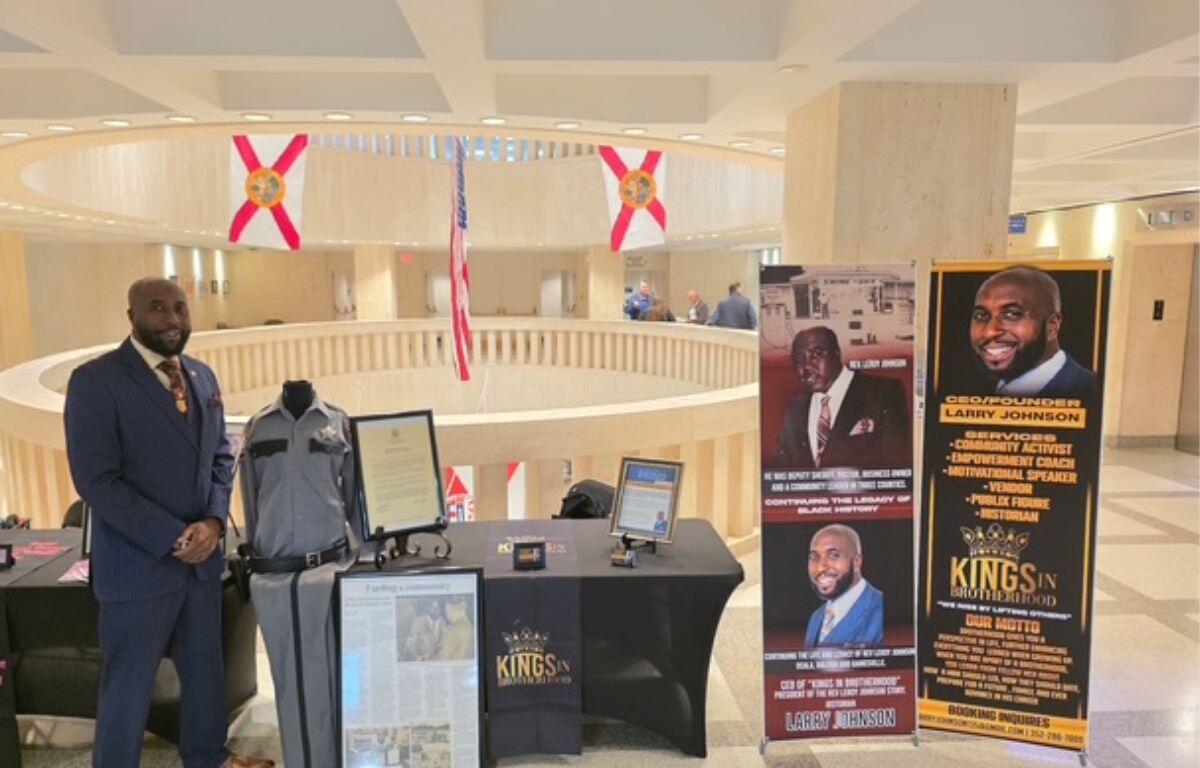

OCALA, FL (352today.com) – It was a surreal moment for Ocala’s Larry Johnson to be back at the State of Florida’s Capitol in Tallahassee, as he was asked once again to present the story of his father–community leader, businessman and activist Rev. Leroy Johnson–for Black History Month. It was something that Larry Johnson could’ve never envisioned.
The younger Johnson, who has followed in his father’s footsteps, is the founder of the Kings in Brotherhood, an organization that has helped lift others within the African American community.
“I’ve seen as our culture as a whole, change from my youth until the present,” said Johnson. “In my teens and early 20s, there was more togetherness. We’re not in the same family, but we’re the same color, but we’re still brothers. But now, it’s too much hating on each other, and I blame the rap music and the rap music culture on this division that we have, not only in Ocala but in all Black communities in the United States of America.”
But how do you address the divisiveness, getting people involved and engaged working toward solutions? Johnson believes those who are 20 to 30 years younger than him, should look at the example of people in his age group and how their collaborative efforts make a difference, demonstrating solidarity and unity, so they would have a better understanding.
“Right now, a person like me, as a community leader, I’m not so much their cup of tea,” said Johnson. “These rappers are their idols, and they’re portraying a drug dealers’ lifestyle in their music. They’re not drug dealers, but they’re portraying this image. And that’s how they get their eye with the flashy jewelry, the money and the car.”
Having someone to look up to
It was different for Johnson when he was a youth, with his role models being his father, Muhammed Ali, professional wrestlers Dusty Rhodes and Steve Austin, and the Six Million Dollar Man.
“Even watching ‘CHIPS’ patrol in the ’70s and ’80s, knowing that my dad was a former sheriff’s deputy, I’m looking at these guys riding on motorcycles patrolling as cops, I thought that was cool,” said Johnson. “With my dad, when people had a problem, they came to him.”
Back in the 1970s, Barnett Bank and Sun Bank weren’t giving people of color loans, said Johnson. However, since his father had his own business, he could go to Barnett Bank and get a loan in his name and give the individual the money that they weren’t able to obtain, and they would be able to start their business. People in the community were inspired by Leroy Johnson’s entrepreneurial spirit.
Rev. Leroy Johnson was inspired by the business acumen of the people he interacted with in Harlem, N.Y., and brought back those ideas when he returned to Ocala.
“He saw these guys walking around with suits on, in the middle of the week, not when they were going to church on Sundays,” said Johnson. “Men in the middle of the week wearing suits and dress shoes, women wearing dresses. He didn’t see that here in Ocala in the ’40s and ’50s at all. But by going up north, he saw that, and that’s what he wanted. And when he started doing that in Ocala, in the ’60s, wearing suits, people began to say, ‘why do you have on white man’s clothes? Only white men can wear suits.'”
Rev. Johnson would also have racial epithets cast at him for wearing suits, but he didn’t let that deter him, said his son.
“If you ever saw him, he either had his gas station uniform on, and if you didn’t see him with that on, he had a three-piece suit on,” said Johnson.
Pride and professionalism overcome prejudice
Rev. Johnson brought a sense of professionalism and dignity to every role he held in the community, whether it be as a Marion County Sheriff’s Office deputy, owning a diner on the square, owning multiple gas stations, including one on SR 40, that was in the Black community, allowing him to be a far greater presence.
“Being right by the auditorium and Parkside, there were so many people that he was helping, from 1970 to 1985,” said Johnson. “When it was cold, people who couldn’t afford to get kerosene but had kerosene heaters, he would let them get the kerosene for free.”
Rev. Johnson’s life story was constantly evolving, and he gave this advice to his son: It’s not how you start, it’s how you finish, everything that you do in between is going to be part of your legacy.
“He never let anybody or anything stop him from what he was trying to achieve and keep him from his commitment to helping others,” said Johnson. “He always strived to do better and to be better.”
Johnson has taken his father’s life lessons to heart, although his father faced far greater adversity, having to contend with and confront pre-Civil Rights Era racism and bigotry, he didn’t let that stop him.
“But now, with this generation, the only thing that’s stopping them from doing anything, is themselves,” said Johnson. “I didn’t let my parents’ death, my father died in 1998, my mother in 1999, it was a setback for a while, but I overcame it. The stroke that I had in 2002, with my left side being paralyzed, that was a very big setback, but I overcame it. I am a product of this community. I am a product of this society. If I can reach out and touch as many people as I can across the State of Florida, nationally and worldwide, so the average little Black kid that looks at me, he can say, ‘if he did it, I can do it too.'”