


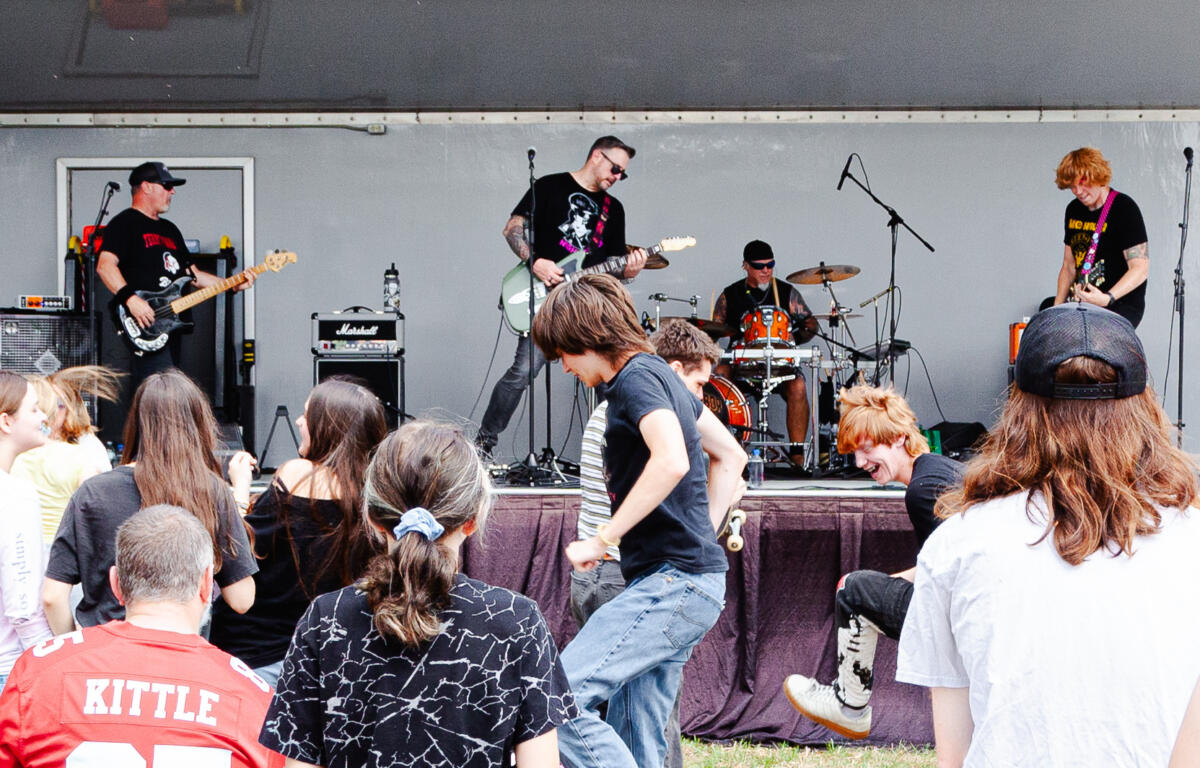

OCALA, FL (352Today.com) – Some local music fans remember Ocala’s punk/emo/hardcore scene from two decades ago. Back when there was a website called slocala.com and shows were cell-phone-free because nobody had one. Before the iPhone was created, Facebook became a verb, and life became digitized, the “scene” in Ocala was where alternative music fans found escape from the trappings of tradition, order and life.
For Ocala residents who are unaware, that underground world revolved around a vibrant network of DIY shows at church halls, the old armory at Tuscawilla Park and The Capitol venue, where bands like Seventh Star laid the groundwork for a thriving Christian and secular hardcore scene. Sites like slocala.com served as the digital bulletin board, long before social media, for announcing gigs, trading mixtapes and connecting kids sporting checkerboard Vans, band tees and studded belts. It was here that Underoath formed in 1997, fusing black metal aggression with emotional hardcore, and where local teens, including Jeremy McKinnon and Tom Denney, started A Day to Remember in 2003. By fusing infectious pop-punk choruses with crushing breakdowns, they created a sound that would carry Ocala’s name far beyond Marion County and onto the national stage.
Today, the Ocala “scene” is alive and well. It just has not been talked about much. Until now.
If someone were to move to Ocala from out of town, curious about getting plugged into the local punk scene, Taylor Schoenborn says they need to head to intimate downtown bar, restaurant and venue Mutiny.
“I would tell them to go to Mutiny or go to the Mutiny Facebook page and look at the events that we’re having and come to a show that would most interest you,” Schoenborn said.
Schoenborn wears multiple hats as both bartender and part-time sound tech at Mutiny, and as a member of the band Glizzy Gillespie.
“Because most of the time, we get a lot of musicians that come to the shows that aren’t just playing the music at the show. With the scene kind of reforming itself, there’s lots of people out there looking for bands that are in that same situation,” said Schoenborn. “And I do get that question from musicians: ‘Where do I go to try to find other musicians, other bands, and stuff?’ And that would be to come out to the live shows and talk to people. We’re all pretty nice, and our punk scene is pretty friendly, and everybody understands what it used to be like and what it is now, and just appreciating that and wanting it to grow. People, even if they don’t have a band that you can join, they might know a guy, and it’s pretty open. It doesn’t seem to be competitive like some music scenes in other cities.”
Evan Batsel of the punk rock band Field Trip agreed.
“I would tell them to go to Mutiny, look up their Instagram page, find the shows there, and once you follow a lot of the bands that play there and follow Mutiny, you’ll see a lot more gigs pop up on your feed that you can go to around town, and a lot of it is online now. But like following all the right people to see when those things happen is really important to it,” Batsel said.
Seph Pyle of the band Not Promised Tomorrow added, “If someone just moved here, I would tell them to keep an eye on Mutiny and some of the local bands that frequently play there.”
Chris Ruppel of the band Love Kills Joy was direct in his advice to a newcomer looking to connect in the local scene.
“Go to Mutiny. They are probably ground zero in my opinion of the punk scene here in Ocala. I mean, O’Malley’s has shows, but I’d argue Mutiny is the punk bar in Ocala,” Ruppel said.
Jason Jones of the band Ugly Neighbor, who has been part of the Ocala scene since the early 1990s, reflected on the old days.
“So, we played with Underoath, and this was going way back when,” he said. “It was sort of when the scene was mostly centered on like the Tuscawilla Youth Center, and so these memories are very foggy. This is a few years ago, but yeah, A Day to Remember, we played around them. They played at the Capitol a lot before they broke big. You know, at that time we were playing venues like O’Malley’s and other places. It always will be a small scene because it’s a small town. But in those days, I think it was a little more divided than maybe it is these days.”
The current scene, while smaller than its peak, carries a strong sense of community and energy. Brian Skotcher of the band Not Promised Tomorrow applauds it.
“The scene in Ocala is amazing,” Skotcher said. “I’m still new to the Ocala scene but have already experienced a very welcoming, family-like environment. I just joined Not Promised Tomorrow two months ago, so I’m the newbie. But the Ocala metal scene is really good with a bunch of talented bands. The crowds really get into the shows, too. The energy we get to share with the crowds is incredible.”
Andrew Lavelle of Not Promised Tomorrow described the scene as “full of energetic, enthusiastic and creative individuals.”
“The crowds are happy to engage and participate; the local music and arts scenes have tons of support,” Lavelle said.
Odie Paul of Not Promised Tomorrow chimed in to describe the scene in Ocala as “very much alive and ready to hear local music.”
“The energy at Mutiny is very fun, everyone is very friendly, and the crowd is very close and right there with you,” Paul said.
Punk’s traditional political and social edge is still present for some.
“A lot of [punk] is also the politics that I’ve grown to really agree with. I had never been really political, but then getting into punk, I did research into what the beliefs behind punk were, and those left-wing ideologies or something that really appeared to be just like ‘care for everybody and not for just those one percenters at the top’,” Batsel said.
Jones reflected on the broader meaning, noting that punk has traditionally been nontraditional in terms of politics.
“Punk has always really been about rebellion and really about expressing angst and searching for meaning and things a lot of times. What it really is to me is you’re sort of searching to reconcile all the confusion going on around you, you know, and you’re not always making a statement when you say something loud. Sometimes you’re just letting it out,” Jones said.
Local support, especially at Mutiny, has been key to the revival.
“Sam Betty at Mutiny has just been a godsend from that perspective, and I think what sets us apart is that size,” Jones said. “It’s such a tight community, and I can say of all the bands that have come through Ocala, of all the bands that you know locally that we’ve played with, everybody’s very complimentary of just how tight and friendly a community we have. And for me, that’s very important. You can go play music and swap attitudes and egos anywhere in the world. But it’s nice to be based out of some place where you know you have friends, and you know you have support, and you know you have people that will show up even if their band is not playing. I just love that.”
“Mutiny is home. They affectionately call us the house band,” Ruppel said.
Yet challenges remain, particularly around venues and reaching younger fans.
“There’s really only a couple of venues around town that like to host punk shows. A large demographic of this scene is younger people, and a lot of them can’t go to any of these shows. And, a big problem with it is that there’s not a huge number of bands like us in Ocala. And, if you want to host a show, if you want to put one on, you need something like three bands to have a good show put on,” Batsel said.
“I think it’s about oversaturation on the internet. You know, so for example, when we were promoting a record, just as you kind of take a look at all the other promos that are out there, it’s like it’s like a cricket chirping in a busy city street,” he explained.
“A lack of a really, really solid all-ages venue would be another thing because we’ve got such a great up-and-coming, passionate bunch of young punkers, but they don’t necessarily have anywhere that they can go that’s not a bar, and that’s hard,” he continued.
Despite the hurdles, the local original music scene seems to be in a period of reformation and quiet growth.
“The Ocala music scene died for a while because all the venues shut down pretty much after the Capitol shut down. Most other places were already gone,” Schoenborn said. “Churches that used to house shows and be venues and stuff stopped doing that for a while, and it was really like O’Malleys putting on some shows here or there, but they weren’t putting on a lot of shows. And I feel like it didn’t necessarily stop people from creating bands or writing music. It just didn’t give them an outlet or a place to play. It’s hard to kind of go out of town and put yourself out there. It’s hard enough to put yourself out there in your hometown, but to drive somewhere where you’re a stranger and do that is even more difficult. So, I feel like it just kind of put a halt to local Ocala music, and Mutiny’s kind of given us that place that starts at the bottom.”
Looking to the future, hope centers on expansion and youth involvement.
“The scene isn’t where it used to be now, but that is in no way saying that it can’t grow because when you keep in mind the fact that Ocala is one of the fastest-growing cities in all of America for the last couple of years, it’s kind of inevitable for something like that to happen… With the way politics are right now, a lot of people are moving towards more leftist ideas, more revolutionary ideas, rather than the norm that has been established for the last couple of years. So the leftist ideologies of punk, aligning with that, also means that there might be a good chance for the scene to grow,” Batsel said.
Schoenborn echoed the optimism.
“I would love to see another venue open up, something with some more space to have larger acts be able to come through here. I would love to just continue to see more bands being made,” he said.
From the church halls and Tuscawilla armory of the early 2000s to the intimate stage at Mutiny today, Ocala’s punk, emo, and hardcore scene has always been about more than just the music. It’s about finding your people in a town that doesn’t always make it easy. Schoenborn captured that persistent drive when he said the biggest inspiration he draws from Ocala is “struggling to be heard and wanting to try hard enough to be heard in a town like this, where there aren’t a lot of places to go, and there aren’t a lot of people to listen, just makes me want to work harder at it.”
The energy is real, the community is vibrant, and a new generation is ready to plug in. If you’ve been waiting for the right moment to check it out, head downtown, catch a show and become part of whatever comes next.