


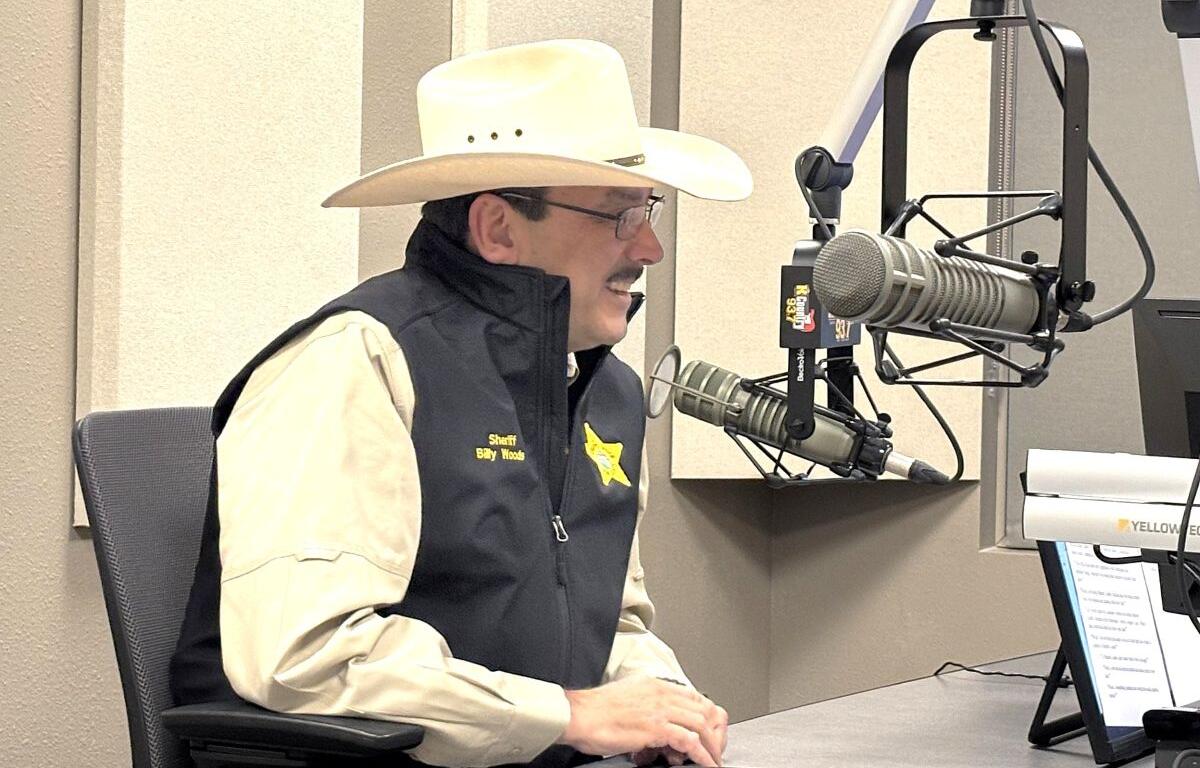

OCALA, FL (352today.com) – Marion County Sheriff Billy Woods, the county’s top law enforcement officer for a decade, stopped by the Ocala offices of North Central Florida Media Group on the morning of Thursday, March 19, 2026, to sit down first in the studio and on the air with radio stations 93.7 K-Country and WIND-FM 92.5/95.5 FM, and then with 352Today.
While speaking with K-Country’s Mr. Bob during his morning show, Woods addressed the persistent claims, spearheaded largely by the reporting of the Ocala Gazette, that Marion County’s jail has one of the highest rates of inmate deaths in the state. (Most recently, the Gazette called the facility, which predominately houses charged individuals awaiting the disposition of their criminal cases, “second only to the facility run by the Jacksonville Sheriff’s Office” in terms of inmate fatalities in a March 17 article.)
Woods pushed back against the claims, calling the Gazette a “tabloid” while saying that “there’s a lot of misinformation” and “a whole lot of dynamics at play.” He cited 45 deaths of persons in MCSO custody over 10 years, a number he said is well within the national occurrence norm.
(The sheriff put that annual norm at “about 2,000” but may have been incorporating numbers for other types of incarceration–according to data from the Bureau of Justice Statistics, the number of deaths of persons in local jails awaiting trial is estimated to be closer to 1,200 per annum.)
“Let’s be realistic–a lot of the people who are coming in are not the healthiest people in the world,” said Woods. “We have to take ’em with whatever illness or ailment they might have. I’ve had [inmates] with Stage 4 cancer, with liver disease, on dialysis. And they have better access to health care than you or me [while in detention]… 97 percent of those 45 died in the hospital.”
He said that still, he understands the concern about anyone passing away while in custody.
“Of course relatives are concerned, they want to know what happened,” he said. “Of course it’s not what you want.”
WIND-FM morning host Hunter asked Woods about the perception that drugs seem to be “everywhere” in Marion County.
“Drugs have always been there [in society],” Woods said. “Unfortunately, [it’s one of the reasons why] we have job security. It’s like the hole in the dike–you stick your finger in and another leak springs up. Narcotics change over time, and fentanyl is still number one right now, but drugs don’t discriminate, they’re always around.”
All of the radio personalities asked Woods about the reality show “Chopper Cops,” which featured Marion County’s tactical aerial law enforcement specialists for two seasons on streamer Paramount+ beginning in 2024. Woods responded with a grin that while he couldn’t speculate or say more, talks about a third season are ongoing.
In a conference room following the on-air interviews, Woods reflected on how law enforcement has evolved along with the explosive growth of Marion County during his 36 years as an LEO.
“Absolutely, law enforcement in and of itself has,” he said. “Day one, there was no computer in my car. It did not exist. In fact, the cellphone didn’t even exist when I started. The radios we used to communicate with each other were rudimentary, and didn’t always work.
“Even that has changed to, right now I can pull up an app which has my radio channels, and I can communicate with this iPhone right here. The computer in our cars has changed how quickly we can identify individuals, getting information that leads us to the capture of a criminal.”
Woods credited a number of other technological advances with helping law enforcement keep up with a growing and changing populace, from Ring and business security cameras to officers’ bodycams. The tech has also streamlined interagency cooperation and information sharing, critical elements of policing an area as large and diverse as Marion County. He credited a deft balance of intelligence-gathering and engagement-based enforcement, aided by these technologies, as an effective overall strategy that continues to be refined over time.
“Before my time, law enforcement didn’t engage, they were more of the abrasive, rough, ‘walk right in’ type. They didn’t go play basketball with the kids on the street,” he said. “Now you have it where law enforcement engages with their communities, their subdivisions. They build relationships with the kids, they build relationships with the criminals, you know? That’s how it works.”
Woods also addressed another point of public contention: Sentences and plea deals that seem far too lenient to residents who spread their dissatisfaction with outcomes far and wide on social media. He took pains to emphasize that much of the time, law enforcement has little influence over how criminal cases are prosecuted, resolved–or dismissed.
“I’m blessed [to be] in this Fifth Judicial Circuit, Bill Gladson is the best state attorney in this state, I don’t care what anybody says. And even my public defender, [Michael] Graves, he is an awesome man. He knows what his job is–it’s to protect the process and protect the people’s rights, not try to get people off. The man protects the system… He’s a good man.”
But he admitted to frustration in some cases.
“Oh absolutely. It occurs all the time. Do we have a perfect system? No. Do we have the best system, the best criminal justice system in the world? Yes. But there are failures. There are flaws.
“Law enforcement is the birth, it’s the beginning of that process. We are the ones that recognize a crime occurred, we’re the ones that gather the information and then identify the people and put them in custody so that they can go to the next step, which is the state attorney’s office–it becomes their burden.
“Now in the beginning, we have a huge burden, and here’s where it sometimes breaks our hearts, where it frustrates families of victims, is I’ve gotta get it right. I’ve got to collect the evidence. I can’t rush the case. Yeah, everybody wants an arrest right now, but sometimes an arrest right now is not the answer, because the [desired] end result is getting justice for the victim, right?
“Judges, they get frustrating. Sometimes [suspects] don’t get the penalties they deserve. They need to be held accountable; we don’t put them right back out on the streets. Now every crime is different, and I’m not going to say that every single crime needs to be [sentenced] to the full extent. Every incident is different, I don’t care what anyone things, believes or says, they’re all unique. And that particular crime is what you need to look at… And we’ve got some judges that just want to push [cases] out, and that is aggravating to us because we go through the hard work of arresting them, and [set things up] to get what they deserve, and then the judge says, ‘oh, let’s just put you back out into society.'”
When asked if there are any peculiar or unusual crimes associated with Marion County simply due to its culture or industries, Sheriff Woods confirmed that a region’s makeup does absolutely inform the makeup of its crime.
“The answer to that question is yes. Cattle rustling! Cattle rustling still occurs, although not in the form that we’re used to seeing on TV,” he said, before becoming more serious. “We’ve had numerous cases. Being the Horse Capital of the World–I know Kentucky doesn’t like that, but we are–and with all these horse farms, we have crimes unique to them as well. We’ve had individuals go onto our horse farms at night, killing a horse, and processing the meat off of the horse out in the field. It’s not unique specifically to us, it happens in Manatee because of all the farmland, in Polk because of all the farmland, but those crimes do occur more often here than people know.”