


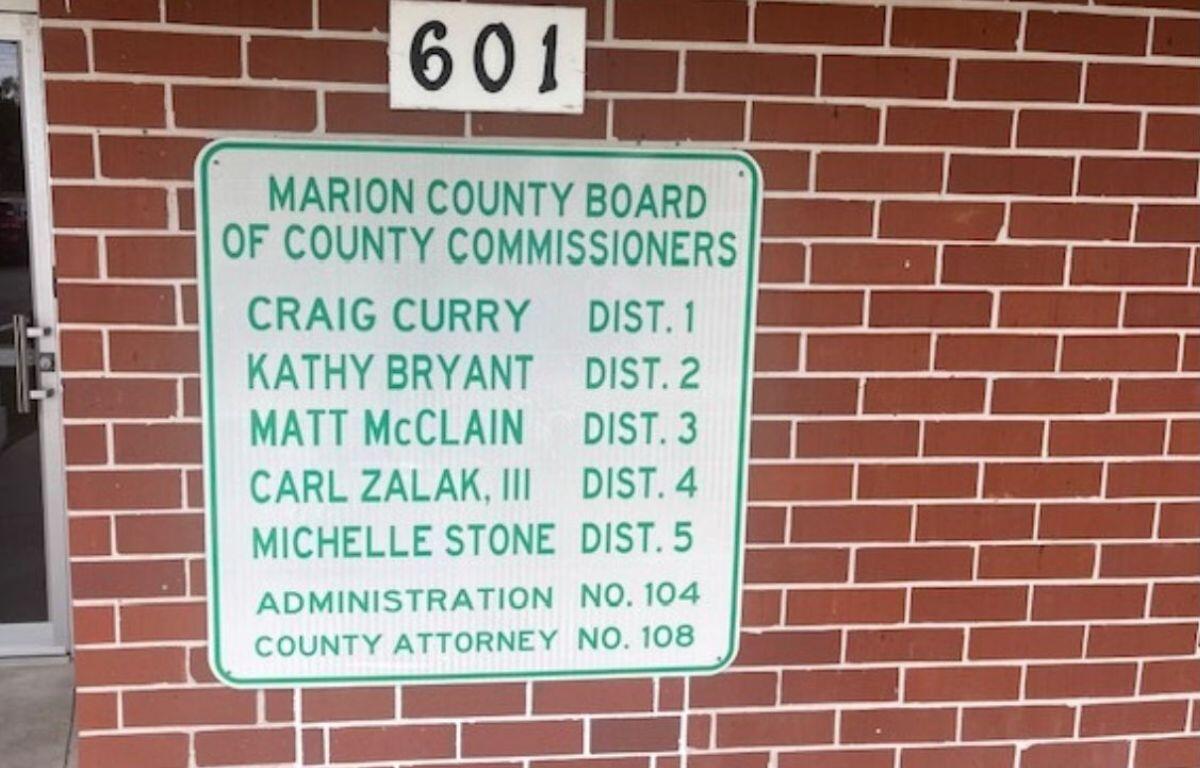

OCALA, FL (352Today.com) – Data centers have taken the stage both nationally and locally in debates over water, power bills, noise, and who gets the tax money. Marion County commissioners spent Monday afternoon trying to decide what that fight should look like here before anyone files an application.
The workshop was held on September 21, 2026, at the McPherson Governmental Campus Auditorium. Growth Services Director for Marion County, Chuck Varadin, requested the workshop and put it on the agenda (File 2026-24368) as a presentation only. The purpose was to get broad direction on how to review a future data center, then go write rules. Chairman Carl Zalak, III opened with the limit.
“The purpose of today’s workshop is not to approve and/or reject a data center. We have no application in front of us today,” he said. “This is an opportunity to do the work before an application ever arrives in Marion County.”
The job, he said, is “to understand the facts,” set “responsible guardrails,” and protect “our natural resources, our ratepayers, and the character and the love we have for our community.”
In an August interview with 352Today, former Ocala Mayor Kent Guinn said the same thing about paperwork. “There’s no special use permits that have been filed at this point, but I mean, but yeah, [data centers] are being discussed. So, that’s all I can tell you on that.” He would not name a project. He said he has been studying data centers, and one project in particular, “since November of last year.”
“I’ve spent probably a year with the one that I’m talking to you about, and I’ve just learned a tremendous amount over that time,” Guinn said.
After 24 years in local office, and now serving as the Director of Governmental Affairs for Douglas Law Firm in Palatka, his advice was to write the standards first. If Marion County allows a data center, he said, “it needs to have the following features: it can’t use a lot of water, or it has to be closed-loop and not use water. It needs to not raise utility rates…or use alternative energy, via gas.”
What the state already locked in
Marion County Attorney Matthew Minter said Senate Bill 180 is not freezing the county. Senate Bill 484, effective July 1, keeps zoning local and sets rules that used to be negotiated. The board on Sept. 15 approved a 12-month pause on commercial data centers of 50 megawatts or more, the same large-load threshold in Senate Bill 484.
Projects under that size are not covered by the freeze. They would still need a special-use permit.
Utilities must file Public Service Commission tariffs by Oct. 1 so large-load customers “bear [their] own full cost of service” and do not shift it onto other ratepayers. Minter said that tariff line starts around 20 megawatts. Duke Energy has challenged the filing, and as of Monday’s meeting, the outcome of the challenge was unknown. Reclaimed water is required when the pipe is at the property line and “feasible,” which is language that can invite a waiver, according to Minter.
Guinn put the rate question more flatly. “It’s against the law to raise people’s rates for a data center, so that’s not going to happen anyway… Plus, if it’s off the grid, it’s really not an issue. You can do it with gas turbines.”
The workshop did not treat that as settled. The tariff is not final. Isolated gas turbines were the example. Loudoun County, Va., Vice Chair and Ashburn District Supervisor Mike Turner called it “an absolute disaster” due to being noisy, dirty, and pumping fine particles next to homes.
Loudoun’s six tests
Turner, who works for the Virginia county home to “Data Center Alley,” told the board there is “no such thing as a good or a bad data center.” Siting and rules decide that. His list rests on six tests: noise, power, water, emissions, setback, and appearance. Never allow by-right data centers. Never sign a nondisclosure agreement. Put standards in the comprehensive plan.
“By-right” in this context means the zoning already allows the use. If a data center is by-right, the company can build it after staff checks the code; the county commission does not get a yes-or-no vote.
Loudoun treated them as office parks in 2000. That made them by-right. He now has four hyperscale data centers that he cannot vote down. By-right ended there on March 18, 2025. He graded Loudoun a failure on five of six tests. Water is the only pass.
On jobs, Turner was blunt in his assessment. “I would not consider data centers to be a major source of job creation for your community.” Construction is the spike. “When they’re done building, it’s going to be 30, 35 people running the building.”
Guinn described a much larger payroll on the project he has been following: “Jobs probably, you know, 200 full-time jobs paying between probably, you know, $80,000-$100,000 a year. Some of these electrician jobs pay in the neighborhood of probably $200,000- $280,000 a year.” Construction, he said, would take “around, gosh, 2,200 jobs for about two and a half years.” He wants high school and Marion Technical College training so a student could “do an electrician job, making a quarter of a million dollars a year.”
Those figures line up with Turner only as a multi-building campus, not one data center.
Tax money
Turner gave Loudoun’s books: about $1.3 billion next year from 233 halls at $4.15 per $100 of value.
Guinn put a local number on “one that we were looking at”: “probably about $155 million in tax revenue to the county.” About 45 percent, he said, would go to the school board, then fire, then the county. He tied it to a possible November homestead measure. “I think Marion County was due to lose about $9 million. This particular project would produce to the county about $9 million.” He added that data centers “are not asking for any property tax exemption at this point. I don’t think they plan to.”
Commissioner Michelle Stone asked whether Marion could create its own data-center tax rate. Minter said no, not without a state statute.
Closed-loop is the rule they described
Turner said he would not allow an open-loop plant. Loudoun’s 233 closed-loop data centers still use about 10 percent of that county’s yearly drinking water. When the loops dump, they can carry chemicals that the sewer plant has to treat.
Guinn pointed to newer chips. “Nvidia came up with one that uses a gel. It doesn’t even use water…They use a gel to cool the chips.” He said some sites that “used to talk about…5 million gallons a day” are “down to where they only use like 50,000 gallons, and even that water is recirculated.”
Clay Coarsey of the St. Johns River Water Management District did not describe a zero-water data center. He said a new use has to take “the lowest quality water source available,” and that if reclaimed water is at the site, “it’s a tough sell” to claim that is not feasible. Recirculating systems, he said, are “something that the district would really be pushing.”
On supply, the district would look at “the water that’s being extracted” and “what sort of potential impact would that have to existing legal users and our natural systems pulling that water out of [the] aquifer.” Any self-supplied “AI data center,” he said, goes to the governing board for a public hearing, “regardless of size.”
Silver Springs and a coming minimum level for Lake Weir “will really be the primary constraints for water supply here in Marion County,” Coarsey said.
Guinn said many of the fears people still raise come from “old information from like two, three years ago, and all that’s completely changed,” including newer cooling that uses far less water.
Turner’s presentation treated other problems as live ones in Loudoun: the low-frequency hum known as infrasound, new high-voltage lines, noise rules that are hard to enforce, and speculators who file a site plan before they have a tenant. He did not describe those as issues that had already passed.
On the “AI data center” label itself, Turner said: “When people started talking about AI data centers, I kind of cringed. Every data center is an AI data center.”
What matters, he said, is how the building is used. A training center teaches the model. It can be huge and sit out in the country because speed to the customer is less critical. An inference or co-location center serves users in real time, so latency matters and the building usually sits closer to people and fiber. Loudoun’s mix, he said, is mostly co-location at about 100 to 300 megawatts, with some hyperscale halls at 600 to 700 megawatts and gigawatt campuses in planning.
What Marion can do now
Marion County Deputy Growth Services Director Kenneth Weyrauch said the code is “pretty mute on data centers.” They need a special-use permit. A filing today would take roughly two to three years to become operational.
Zalak asked how the county would keep watching noise after a data center opens. Technology changes, he said, so a one-time test after construction may not be enough. He recalled “an application, a year back or so,” and asked whether the county could require sensors that monitor sound around the clock.
Turner said the sensors are the easy part. The problem is what happens when the reading is too high. In Loudoun, he said, a deputy can confirm the noise and still will not shut down a billion-dollar building. That is why he wants the state to let counties raise taxes on a data center that breaks the noise rule until the company fixes it.
Michelle Morrison of the East Central Florida Regional Planning Council said the region is “building the plane as we’re flying it.” Lake County is on a 90-day freeze. Volusia is moving a ban. Orange is grouping halls by power, with extra concern at 20 to 50 megawatts. “I doubt that anybody in our region would want to be identified as Data Center Alley,” she said.
Turner said Loudoun County has “the highest concentration of data centers on planet Earth” and is “the home to Data Center Alley.” There has not been “a single day in 16 years where there was not a data center under construction somewhere in Loudoun County,” he said. The inventory is now 233 buildings built or under construction, with 53 million square feet on the ground and another 60 million in the pipeline. Virginia as a whole has about 600 data centers, he said; Texas has about 440 and California about 290. That density is what other counties mean when they say they do not want to become the next “Data Center Alley.”
The leftover fight
Commissioner Kathy Bryant asked the board to reopen last week’s pause. “I think 50 is too high. I would respectfully ask that the board bring that ordinance back and change that from 50 to 20.”
Turner agreed. A 49-megawatt hall, he said, “could violate every one of the six factors” and escape extra scrutiny. Every state line he has seen uses 20 or 25 megawatts.
Commissioner Matt McClain said leave it. “We don’t have a by-right problem here…. If there’s one little thing wrong, we can say ‘no.'”
Commissioner Michelle Stone agreed. Commissioner Craig Curry said Bryant was “onto something.” Bryant noted the board can lift the pause early once the rules exist.
There was no vote. Zalak said they can take it up at the next regular meeting. Staff will draft from Turner’s list, then hold another workshop, Land Development Regulation Commission review, and at least three public workshops before anything is written into the code.
A list of upcoming county meetings can be found here.