


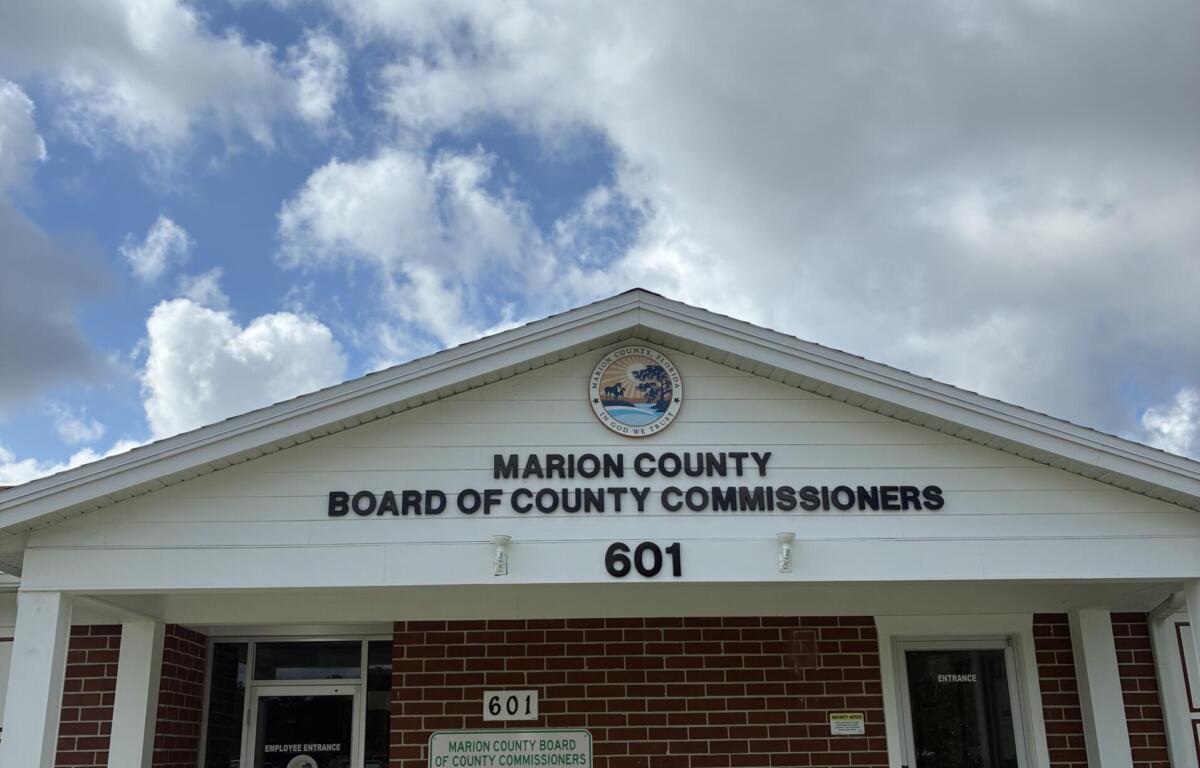

OCALA, FL (352Today.com) – If you operate a roadside food truck, boiled-peanut or produce stand, or Christmas tree lot in Marion County, the rules that govern you may be about to change. At an August 26, 2026, public hearing, the Marion County Board of County Commissioners took up proposed Land Development Code amendments that would rewrite how temporary roadside vendors can operate and then sent the draft back to staff after vendors said the language was too vague and, in places, too harsh to follow.
The item, Section 4.3.12, would rename “roadside vendors” as “temporary roadside vendors” and cover food trucks, Florida Department of Business and Professional Regulation-approved carts, produce stands, peanuts, Christmas trees, firewood and fireworks. Kenneth Weyrauch, deputy director of Growth Services for Marion County, told commissioners that much of the draft was meant to clarify language already in the code since 2013.
“The language provided today, we’re looking at trying to provide better clarity of the language that’s in the code today,” Weyrauch said. “We think it’s less restrictive.”
Under the proposal, two vendors could operate on a parcel with the owner’s permission. “They can’t be in the rights-of-way. They can’t be in the easements,” Weyrauch said, “and they are intended to be temporary, so that services such as electric, water, and sewer are not permitted, and that’s existing code today.” Permanent structures, he said, “are prohibited, which is current code today.”
More than two vendors on a site would be treated as a food truck park. “If you want more than two trucks and you’re going to be somewhat permanent there, here’s the process,” Weyrauch said: a special-use permit, a site plan, paved parking or a waiver, and permanent restrooms. “If you’re within connection distance of water and sewer, you will have water and sewer on the site for your vendors.”
Staff also wanted driveway permits so heavier trucks stop tearing up the road apron. “Oftentimes we’re seeing where these roadside vendors are just pulling off the road, and sometimes their vehicles are a little bit heavier, and over time that is tearing up or messing up the apron,” Weyrauch said. Code Enforcement Manager for Marion County Robin Huff said the parking rule is meant to keep customers off the shoulder: “What we’re looking for is that there’s an adequate amount of parking on the private property, so that the people that are patronizing these locations are not just driving off the side of the road and parking along the edge of the pavement.”
Signs would be capped at four per vendor. “When you’re driving down the road, and you see the different fruits and vegetables, they would need to limit that to four per stand,” Weyrauch said. Overnight food and gear would have to go inside the vehicle. “Everything has to be inside of the vehicle. They can’t leave stuff outside.”
A published line banning tables and chairs outright, he said, was a mistake left over from the Land Development Regulation Commission. “We agreed that tables and chairs should be limited to two tables with chairs.”
That was the draft. The hearing did not adopt it.
Commissioner Kathy Bryant pressed staff on restrooms, amplified sound, and what “temporary” means if a truck never leaves. “It’s a food truck. You’re supposed to be walking up, getting your food, and leaving. It shouldn’t be a hangout spot,” she said. She wanted a ban on amplified sound written into the land code so code enforcement would not have to haul out a decibel meter. According to Huff, the county already uses a “plainly audible” noise rule: if music can be heard off the property, it can be a violation.
Commissioner Matt McClain called “adequate parking” too subjective and asked that the code require parking on site, off the right-of-way. Commissioner Carl Zalak, III described the line he wants staff to draw: A truck that can still move is temporary; one on blocks, with flat tires, hooked to power and drawing a crowd is a fixed business and should be regulated like one. “We’re trying to parse that line,” he said, between good operators and “bad actors that are causing issues.”
Vendors spent the rest of the meeting addressing gaps in the document.
John Landry of Lux Sprinkles Ice Cream in Ocklawaha said a Duke Energy pole has served his trailer for nine years. “Without the power there, and shutting down, unplugging, and moving every day, is going to be a little difficult,” Landry said. Zalak told him that a semi-permanent site that needs power probably belongs in a special-use permit, not the temporary-vendor section.
Butch Touche of Citra asked the question several operators repeated: if a truck leaves every night and returns to the same spot, is it still temporary? Zalak said yes, as long as it can move. Touche also asked who files the special-use permit when a third truck shows up. The chair answered: the property owner, not the vendor. He wanted overnight food left in the trailer refrigerator. Staff agreed to clarify that storage must be contained, not banned, inside the vehicle.
Margaret Renaud, a lifelong Marion County resident who owns two trucks—one a dessert trailer and another a mobile ice cream shop that had not yet opened at the time of the meeting—said the draft was not specific enough to obey. “You need to define what temporary actually means,” she said. She also challenged a proposed notarized permission slip from the parcel owner, which Weyrauch said was aimed at vendors pulling onto vacant land whose owners may live out of town. Renaud said a casual text is how most of her setups work, and notarizing permission for several sites a week would be a hardship for a small business. “Many of us will follow the rules, but we need to understand what’s being expected of us.”
Commissioners sided with her on the notary. Bryant suggested written permission from the owner or a representative. McClain said securing vacant land is the owner’s job. By the end of the hearing, Weyrauch said code enforcement would only need a name and phone number so they can confirm permission, not a notarized form each time.
Todd Foster, who owns Odd Todd’s on commercial property he bought in Salt Springs, said he has run two trucks there for about nine years, one of them stationary, and also sells farm products under the Right to Farm Act. “Two tables? You’ve got to be kidding me,” he said. “I’m going to be punished because I have a very successful business, and it comes out of a food truck.” He warned a special-use process could hand neighbors a say over a site he said he permitted years ago, and could threaten Walden Farms.
Residents pushed the other direction. Carmen Mervin said produce stands and food trucks are different businesses and should not share one rule set. She objected to trucks settling on A-1 agricultural land, with porta-potties, extra signs and tents that never come down. Katrina Bakewell, who is building a horse farm next to a taco stand she said grew out of a disbanded Marion Oaks cluster, described trash, lights, music and signs, and citations that did not stick. “I didn’t buy the property… so that I’d be next to a kind of noisy, colorful taco stand,” she said.
Attorney Jimmy Gooding warned the board that special-use permits are already capped at 10 a month and that a rush of food-truck applications could stack the queue.
Commissioner Kathy Bryant moved to stop editing on the dais. “There’s a list of all the questions and all the concerns. We’re trying to work through this on the dais, and it needs a lot of work,” she said. Commissioner Michelle Stone agreed there were too many changes. Zalak pulled the item off a Sept. 14 hearing date, sent it back through LDRC, and asked staff to collect contact information from everyone who spoke so they can be notified. He also asked operators who are “doing it right” to send fixes that still deal with right-of-way, restrooms, and fixed locations. A return in October was the working target. No date has been set.
After the hearing, Renaud started a Facebook group for vendors following the rewrite. The name of the group is “Marion County Food Truck Coalition.”
Until a revised ordinance comes back, operators remain under the existing roadside-vendor section: private property in allowed zoning districts, no sales in the right-of-way, and no permanent utilities or buildings on vacant land—without a clear, adopted line between a truck that comes and goes and a lot that has become a restaurant.