


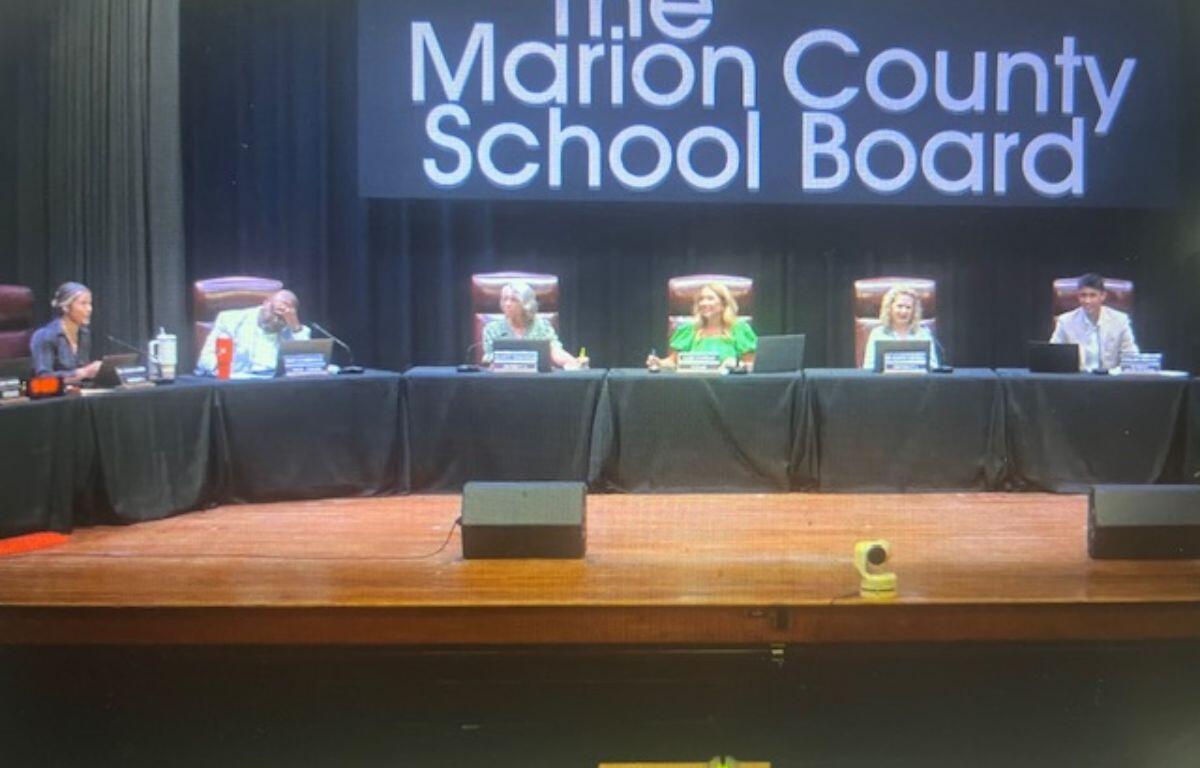

OCALA, FL (352today.com) – Marion County School Board members voted 3-2 on Tuesday, July 28, 2026, to raise employee health insurance costs beginning in 2027, framing the decision as a painful but necessary step to protect the district’s finances and avoid potential layoffs.
The changes to the self-funded health plan include higher employee payroll contributions, increased deductibles and higher out-of-pocket maximums on most options. District officials said the move would help maintain reserves and shift approximately $2.95 million into the general fund.
Public speakers urged the board to reject the proposal, describing the financial strain already felt by many employees.
Emily Parker, an ESE (Exceptional Student Education) specialist entering her 29th year with the district, told the board that when her son was a high school senior at Belleview High School, the family plan premium would have consumed more than 25 percent of her take-home pay. She went without full coverage until her son suffered two spontaneous collapsed lungs that required hospitalizations and surgeries.
“Two hospitalizations, surgery, and follow-up visits wiped out my savings, maxed out my credit cards, exhausted my leave and cost me my second job. Five years ago, your family plan was already unaffordable for many single-parent teachers. Today, you’re considering increasing that cost significantly, not because Blue Cross Blue Shield raised its rates, but because the district wants to build reserves far beyond what the state requires; many of your employees are already working second and third jobs. If you make this insurance even less affordable, you’ll force even more of them to do the same,” Parker said.
“They won’t be sponsoring clubs, volunteering for family nights, or serving on committees,” she continued. “They’ll be working another shift so they can afford to keep health insurance. Others will simply do as I did and go without coverage, hoping nothing catastrophic happens to their family. At 55 years old, going without insurance isn’t an option for me. But I have to ask: Have you considered what happens to the quality of education when experienced educators have to spend their evenings working somewhere else just to pay for the insurance provided by their employer? I understand that costs are rising everywhere, but this proposal isn’t driven by Blue Cross Blue Shield’s premiums. It’s a choice. Tonight, you have the opportunity to choose the people who make this district work. Please reject proposed changes to the self-funded health plan.”
Vicky Treulieb delivered a similarly passionate appeal.
“There’s a difference between a need and a want. I need to drink water in order to survive. I want to drink a Diet Coke. I need to have a shelter to protect myself from the weather. I want that to be a house. You need 60 days’ worth of reserve for healthcare. You want to move extra money to the general fund. My friend’s coworker was in tears over an increase that she can’t financially support. I want no employee to be in tears over issues that can be prevented,” Treulieb said.
“You have spent the past two years callously balancing the budget off the backs of teachers, and that practice needs to stop now,” said Treulieb went on. “Last year, you eliminated positions so that classrooms would absorb a couple extra students per class. Then, at the end of the year, to prepare for this year’s budget, you had elementary schools cut one unit and secondary schools cut two, which again increases class sizes and teacher demands. Now you want to increase health insurance, not out of necessity, but because it seems like a good move for the future. I believe in planning for the future, but only if the present allows me that opportunity. Our present does not allow that opportunity for you. In fact, in an economy with ever-increasing costs, now is certainly not the most prudent time to squirrel away extra money that’s far beyond what the state expects. Cut your employees a break; they are already going above and beyond to meet the crazy demands that keep being stacked on them.”
Helen Hamel, a longtime member of the district’s insurance committee, reminded the board that the self-funded plan was created to protect employees from insurance-company rate swings and to keep savings local. While her own single coverage remains free, she said bus drivers, custodians and other lower-paid staff will struggle with the proposed increases.
“Typically, I’m in pretty good agreement with what we plan to do,” she said. “I have been on this insurance pathway for quite a while. I joined the insurance committee back when we were first making this decision to go to a self-funded option. We went to the self-funded option to protect our employees from the rampant changes that were happening in the insurance agencies. We also went to this plan to be able to embed those savings and those profits back here in Marion County to better serve our employees, not some insurance companies’ bottom line, and we were able to do that over the last two or three years. We have increased coverage options for our members. We have decreased deductibles and premiums, especially for family coverage, and this has made such a difference to our employees. It’s not just teachers like myself, but you have to understand our insurance plan funds and supports employees from all echelons of Marion County Public Schools.
“Don’t settle the budget on the back of the employees, many of whom are going to be struggling to make it enough as it is,” Hamel said.
Mark Avery, president of the Marion Education Association, said the insurance fund currently holds about $30 million, well above the roughly $13 million needed for the required 60-day reserve. Without changes, the fund would still have about $21 million by the end of 2027, he said. The proposed rate increases, he argued, exist primarily to move money into the general fund.
“This affects all the employees of this district, not just the instructional employees, but every single person that has insurance that is not Plan Number One, which was mentioned as the free plan, because there’s a proposed increase to every other plan unless your spouse works for the district, and those are going to be traumatic to all the employees in the district,” Avery said. “That is on the backs of the employees, not just employees I represent, but all the employees.”
Board members acknowledged the hardship while defending the vote.
Board Member Lori Conrad said she felt she was “choosing the lesser of two evils.”
“I am for people, and so I’m choosing to keep people,” Conrad said. She noted she is on the family plan herself and that the decision affects almost everyone in some way. “Marion County has always been fiscally responsible, and I will vote that we continue to stay that way.”
Board Chair Sarah James shared her own family’s situation to illustrate the pressure many feel. Her husband is self-employed, and the family relies on the district’s plan with a supplemental policy.
“We kind of live our life on a prayer and pray that God has our back, because if something catastrophic happened, it would be an incredible financial burden for my family,” James said.
She said the district’s priority is preserving jobs.
“I would rather have you here paying a little bit more for insurance than not have you at all, and that is the reality that this district is facing,” James said.
Board Member Allison Campbell, the board’s liaison to the insurance committee, supported the proposal while calling for a much stronger communication campaign so employees understand existing lower-cost options and new programs coming online. She noted the board had just approved a tentative budget that assumed the higher employee contributions.
Two board members expressed deep reservations about the timing amid high inflation and rising everyday costs, but the motion passed 3-2.
The changes take effect Jan. 1, 2027.