


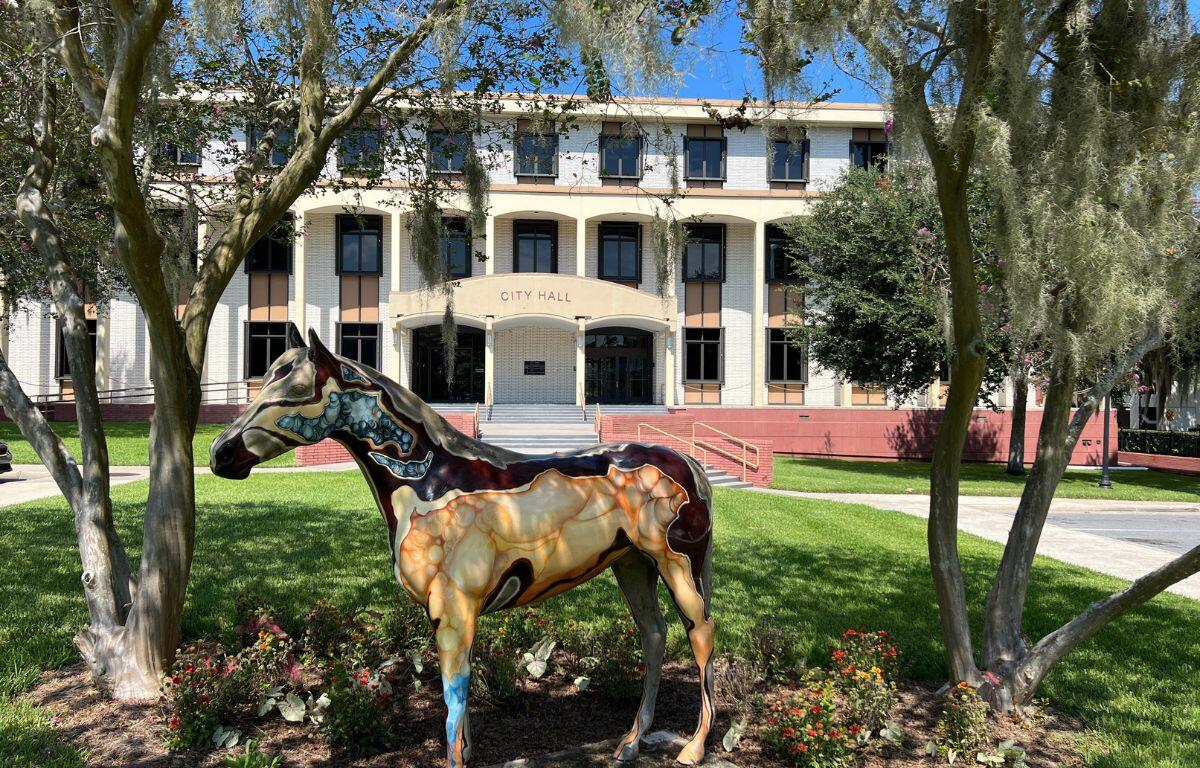

OCALA, FL (352today.com) – The City of Ocala’s Planning and Zoning Commission held a public hearing Monday, April 13, 2026, for the consideration of the city’s Vision 2050 draft.
The commission unanimously approved the recommendation request for Ocala Vision 2050 to the city council, by a 5-0 vote with a recommendation to make, in coordination with Marion County Public Schools, the Safe Routes to School Program a high priority item, under action item 2.5.
Several minor changes were made from the presentation staff made at the planning and zoning commission meeting in March, based on feedback staff had received.
The substantive changes that were made were on item 4.2, which is on page 21 of the draft. Staff expanded the item to include community and cultural heritage and natural resources, said Jeff Shrum, City of Ocala growth management director. On action item 4.3 on the same page, there was language to address connectivity north and south of SR 40 in the downtown area.
Shrum gave an abbreviated presentation of the overall draft, where he highlighted a few items.
Ocala Vision 2050 builds on the success of Vision 2035, which had been completed in 2013.
“As we move forward, some things to keep in mind, and it needs to be a living document as we move forward,” said Shrum. “The progress that we made for 2035 and as we move forward, what do we estimate in population? For 2050, we’re looking at about 92,000 in the City of Ocala. That’s a pretty good increase.”
State preemptions are impacting the city’s ability to do things on a local government level, said Shrum. Technology and demographic changes over the next 25 years are also something to be mindful of.
Changes and transitions
The interlocal agreement meeting on April 1, 2026, between the Marion County Public School Board and all of the local government entities, where data was presented that city staff had been working on, with all of the local governments, was very telling, and puts into perspective the City of Ocala, as one thinks about the city as the centralized urban area for the county. The vacant potential development properties for Ocala and the other jurisdictions were looked at based on the comprehensive plan future land use, said Shrum. Potential development for vacant property is 70,398 compared to the county for that same undeveloped vacant property, 71,348.
“That gives you a really good perspective as to why and how [considering Ocala the hub] is appropriate,” he said.
City staff had this conversation with the planning and zoning commission previously about coordinating with Marion County to minimize urban sprawl from the county to the city, said Shrum.
“These numbers are telling you that our future land use is trying to attract the same amount of development base the county is, in a much smaller compact area,” said Shrum.
Focus on the future
The Ocala Vision 2050 document has five main sections. The first section discusses Vision 2035 and building it up into the 2050 vision; Section two provides the public involvement and the public engagement that staff was involved with in that process. Sections three, four and five comprise its core, said Shrum. Section three concerns the initiatives and action items that are citywide; section four establishes the city’s four focus areas; and section five outlines the next steps of the vision.
The four principal building blocks of the vision document are land use and housing; mobility and connectivity; public and open space; and gateways. The initiatives for each one of the building blocks are split out in each section of the draft, said Shrum.
Citywide initiatives include encouraging mixed use and infill development, aligning land use and infrastructure capacity, and expanding housing diversity–not just types but also income ranges–improving multimodal transportation, and preserving the city’s historic and cultural spaces.
Citywide landscape
Section four of Vision 2050 addresses the specific focus areas, and strategies for focus areas that the city sees primarily as opportunities for future change as the it moves forward. Staff identified four areas: East Ocala; the high-density downtown area; West Ocala; and the Ocala International Airport area, with specific strategies having been developed for each one of those areas.
Notable strategies for East Ocala include exploring opportunities for accessory dwelling units; however, that’s not necessarily specific to East Ocala, and will be considered citywide. It does raise that important component of trying to develop some more affordable options for housing, as well as enhancing and promoting the Ocala Historic District.
For the core of the high-density downtown area, a hospital district was also added into the draft, recognizing the unique character of the area, where there has been a lot of change happening recently. The city wants to be able to adapt and accommodate that area as they change to address the growing area in the hospital district.
West Ocala covers the area west of Pine St., north of SR 40, mostly east of I-75 and to the north to the city limits. The notable strategies for West Ocala include the city’s pursuit of targeted industries such as grocery and service industry, continuing to build out the Mary Sue Rich Community Center at Reed Place area, and also identifying and prioritizing gaps in sidewalks and lighting that work, said Shrum.
The Ocala International Airport includes most of the area of the city west of the airport as well as a portion just to its east. Most of the area is industrial and commercial in nature. As the airport continues to grow, with the possibility of future passenger service, other things will start to emerge, such as hotels, as well as things that you don’t normally see associated with hotels and passenger service, and the city wants to be able to adapt to those forthcoming changes, said Shrum.
The notable strategies for the airport area include improving multimodal transportation for the area and including the SunTran bus system as well as other transportation facilities, to get to and from the airport area through I-75 and to the downtown area to make sure that the city has better connectivity.
The Vision 2050 document also addresses enhancing gateway improvements coming in from West SR 40 to the city. Aspects of the vision concerning the thoroughfare run throughout the paper, because it’s a component of each one of the focus areas. It’s a central corridor that’s going to play a key role as the city moves forward. The draft also updates the land development regulations so the city will be able to adapt to the changes that are going to occur.
City staff’s plan after the receiving the recommendation request from the planning and zoning commission was to go to city council May 19, 2026, for city council approval, and then follow up with comprehensive plan amendments, which will be initiated later this year, said Shrum. Staff also intends to update the study area plans for downtown and Tuscawilla Park. Staff recommended approval of the Ocala Vision 2050 draft.
Safe Route to Schools
Marion County Public School Board member Dr. Allison Campbell, who is a non-voting member on the City of Ocala Planning and Zoning Commission, made the comment that under item 2.5, she would love to see the coordination with Marion County Public Schools regarding the Safe Route to Schools program be a high priority.