



This is the first in a 352Today series on the cost of living in Marion County—not just the numbers, but the people living on them: how they stretch a paycheck, what they go without, and what “getting by” looks like here.
OCALA, FL (352today.com) – Brigid “Bree” Harrell’s kids do not always need a Saturday that costs $100. In an economy that can demand that much in fuel, food, and fees alone on a weekend, stretching a dollar can take creativity.
For Harrell, a sales coordinator with a media company, that looks like taking the long way to Publix, kids in the car, music up.
“Just find something your family likes and do that. It doesn’t always cost money, and that’s what we do,” Harrell said. “We even go grocery shopping together; that does cost money, I get that, but my kids love to go grocery shopping with me because they’re like, ‘I’m going to get out of the house and avoid the laundry.’
“Turn the music up, and we take the long way to Publix versus just the standard way, just spending a lot more time together.”
That is how one paycheck-to-paycheck family in Marion County buys a Saturday without busting the budget on one.
They’re just one of the many families in the 352 looking to stretch their budgets when their income falls below what, on paper, constitutes the cost of living in their part of North Central Florida.
In the Ocala area, food-service jobs are among the largest occupation groups, behind sales, office and transportation work, and they are the lowest paid. They average $16.84 an hour, according to May 2025 data from the U.S. Bureau of Labor Statistics—the mean wage across restaurant cooks, fast-food workers, waiters, bartenders, dishwashers, hosts, and their supervisors, some tipped and some not. A single parent with two children would need $43.33 an hour to cover a basic-needs budget here, according to the MIT Living Wage Calculator for the Ocala metro, the equivalent of more than two and a half full-time restaurant jobs.
That $16.84/hr paycheck falls short of even MIT’s living-wage figure for a single adult with no children in the Ocala metro: $21.23 an hour. Sales, office, and transportation jobs pay more than restaurant work here, but not enough to close the gap for a parent of two. Office and administrative support averaged $21.49 an hour in May 2025; sales and related occupations averaged $22.73; transportation and material moving averaged $20.45, according to the same BLS data.
The average office and sales wages sit just above the $21.23 mark for a single adult. The transportation wage sits just below it. None of them comes close to the $43.33 MIT says a single parent of two needs, which is about two full-time office or sales jobs, or a little more than two transportation jobs.
Bree Harrell sat to talk about how she “makes it” with an active, blended family of four.
Harrell has four children between the ages of 10 and 16. The family lives with her in-laws. The arrangement started about 11 years ago, when health problems, fewer work hours, and a tight budget stacked up. They meant to move out within a couple of years, but that has not happened.
They looked for a house around 2018. Four kids made a standard three-bedroom a problem. Then, prices climbed. They waited, hoping an election might change the market. “And then 2020 took a dive,” she said. “Everything has just gone up and up and up… We just couldn’t afford to do it.”
They are still there.
“We are definitely a paycheck-to-paycheck family,” Harrell said. “Bills are all paid, and groceries, but we are a paycheck-to-paycheck family.”
The hardest hit, she said, has been credit cards, putting charges on plastic to get to the next step, a pattern that picked up about two years ago. The last month she remembers closing in the black was May or June of this year, when extra sales work brought commissions. Summer has been the opposite.
“Our kids eat a lot,” she said. “Summer was hard, trying to keep them occupied and feeding them.”

The grocery bill went up during the summer months. Limiting food seemed like the best way to stretch the dollar.
“This can sound so mean, but limiting [the kids]—’Hey, you guys can’t snack all day. I get it that you’re hungry. Eat these things when you want to snack, not just keep diving into all the chips, all the corn dogs. Like not constantly eating meals every two hours.'”
The blended schedule helps a little. One week they have one child; the next week they have four. There is no daycare. The kids are older, which saves on child care, but costs more at the table.

The squeeze she feels most in Ocala now is fuel. The household runs on one family vehicle. About $1,500 a month goes to her car payment and about $500 to insurance for a teenage driver, roughly $2,000 on that one car. They do not pay rent. Harrell covers groceries and household supplies instead.
They already cut a vehicle to keep the notes from stacking. When she was staying home and not working, two car loans were too much. They sold a truck to make ends meet.
“For me to be at home at that time, we had to do something, and it was to get rid of [my husband’s] vehicle because the two loans for the car payments were too much,” Harrell said. “It put a little bit of stress on us because we rely on the one vehicle,” she said. “Now everybody either has to go, or half of us can go, and then somebody has to wait and get picked up later, and it’s aggravating because you’re waiting for everybody and you’re running late.”
Sports is the bill that stays in the budget. Birthday parties mostly do not. Cheerleading does. After Harrell’s high-schooler made the cheerleading team, the family had three weeks to come up with $1,200. About $400 was due up front. Relatives and friends on both sides donated. Whatever was left, they split with the other parents.
“We’re a very good blended family,” Harrell said.
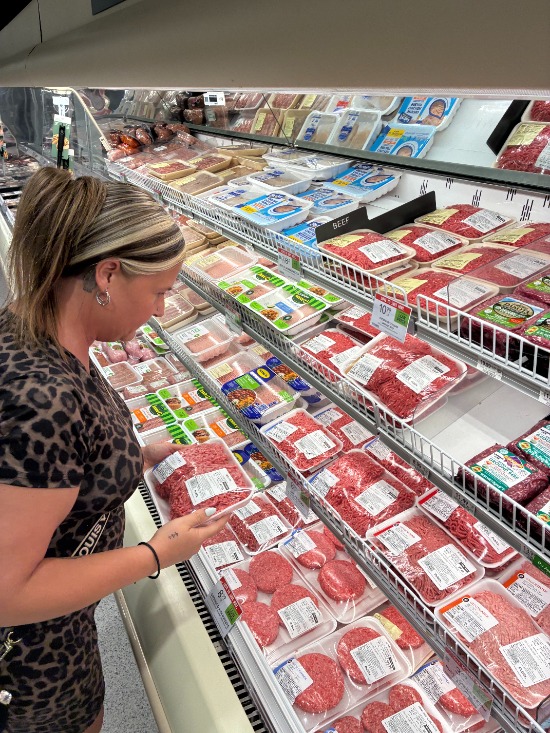
A grocery week is a circuit: Walmart, Publix, Aldi, Sam’s Club. This pattern proves to be one way households can avoid the sticker shock they sometimes face for items if they shop one store—Publix, for example—for everything.
“I switch all of them because prices are different everywhere,” she said. “It’s kind of a pain because I have to make sure I have enough time to go to all of the places and make my list of what I’m getting for each place.”
For Harrell, Publix gets the meat the household prefers, plus BOGOs and digital coupons. Aldi is the favorite for other food items. Walmart and Sam’s cover the household stuff and extras like shower gel.
When money first got tight, Harrell said extras like candy had to go. “I grew up having a candy bowl on the table. But now, none of the extras, like Snickers bars and stuff like that.”
Most nights, Harrell cooks. She did not grow up cooking, however. “I’m not American. My family is not from here. I’m European,” she said. She was raised mainly by her grandparents while her parents worked. Her mother taught her later. With teenagers, the staple is ramen. The other mealtime staples are chicken fries, peanut butter and jelly, and grilled cheese.
Even ramen noodles doubled in price. It used to be about 24 or 25 cents, she said. “Now it’s like almost 50 cents. Even though it’s not drastic, because it’s still cheap, it has gone up.”
Once a week, when they have all the kids, they eat out on a budgeted night: Chili’s one week, Zaxby’s another, whatever the kids can agree on.
What she has gone without is clothes. After she lost weight, she kept wearing what no longer fit.
“[A new wardrobe] wasn’t really necessary,” she said. “I’m the one that chose to lose weight, so it was like, you know what, that can wait. We’ll just hang on to stuff, and it’ll be baggy. It’ll be fine.”
The children, except one son who is covered through his stepmother, are on Medicaid. The family has people they could call for help, but they do not ask them for money. If a $5,000 emergency landed today, they would have to borrow it from her husband’s employer. Savings, when there is any, stays put.
“We don’t touch the savings account unless it’s like an absolute emergency,” Harrell said. “It just gets left alone.”
If you read Harrell the $43-an-hour figure that researchers say a single parent of two needs for a basic budget in the Ocala metro, she does not call it high.
“No, that’s right,” Harrell said. “That’s right. Go to college. Stay in school.”
She went to college. She is not in the field she studied. The job problem, as she sees it, is the family schedule underneath the wage.
“Finding a job for people like me who have the dynamic I have is very difficult,” she said. “Not everybody can afford childcare. So, if you can’t afford childcare, you have to try to find a job that works with your schedule, and then you’re finding a job that’s not paying quite enough for you.”
For families moving to Ocala while depending on food service work, for example, or anyone who thought the county would be cheap, she does not offer a trick so much as a smaller list.
“You don’t always need everything you think you need,” she said. “We’ve done a lot of the ‘Oh, we need this, we need this,’ [but] we really didn’t need it. It’s just something that we wanted, or something that the kids wanted that they thought they needed, but it wasn’t something that’s a necessity, which in turn we could have saved a lot more money by not doing those things. So put the wants away.”
Then she stopped. “I know that’s not a good answer. The situation in this county is getting really bad with it. Everything is just very, very expensive.”
What she tells people to do is cheaper and closer to home. Shop at Aldi, send kids outdoors to play football, go outside, go downtown, she said.
“That’s the one good thing about Marion County,” Harrell said. “There’s lots of free things to do.”
The Harrells’ long-term plan used to be to have a place of their own by the time their daughter finished high school, two years from now, using money they had been trying to save. That plan is closed, as Harrell has added caring for her in-laws to a packed family life.
A Saturday that does not cost $100 is how the week holds. It is not how the budget balances.
MIT puts a basic-needs year for one adult and two children in the Ocala metro at about $90,126 before taxes, $43.33 an hour. A full-time food-service job at the local average of $16.84 pays about $35,000. Add a full-time sales job at $22.73 an hour, about $47,300 more, and the two checks together still land around $82,000. That is two of the county’s biggest job groups, stacked, and it is still short of what the calculator says that household needs.
The long way to Publix is (almost) free. The cost of living in Ocala is considerably more.
(DISCLOSURE: Harrell is a sales coordinator for North Central Florida Media, 352Today’s parent company; she and the author do not work together but have an existing social relationship due to work proximity.)