


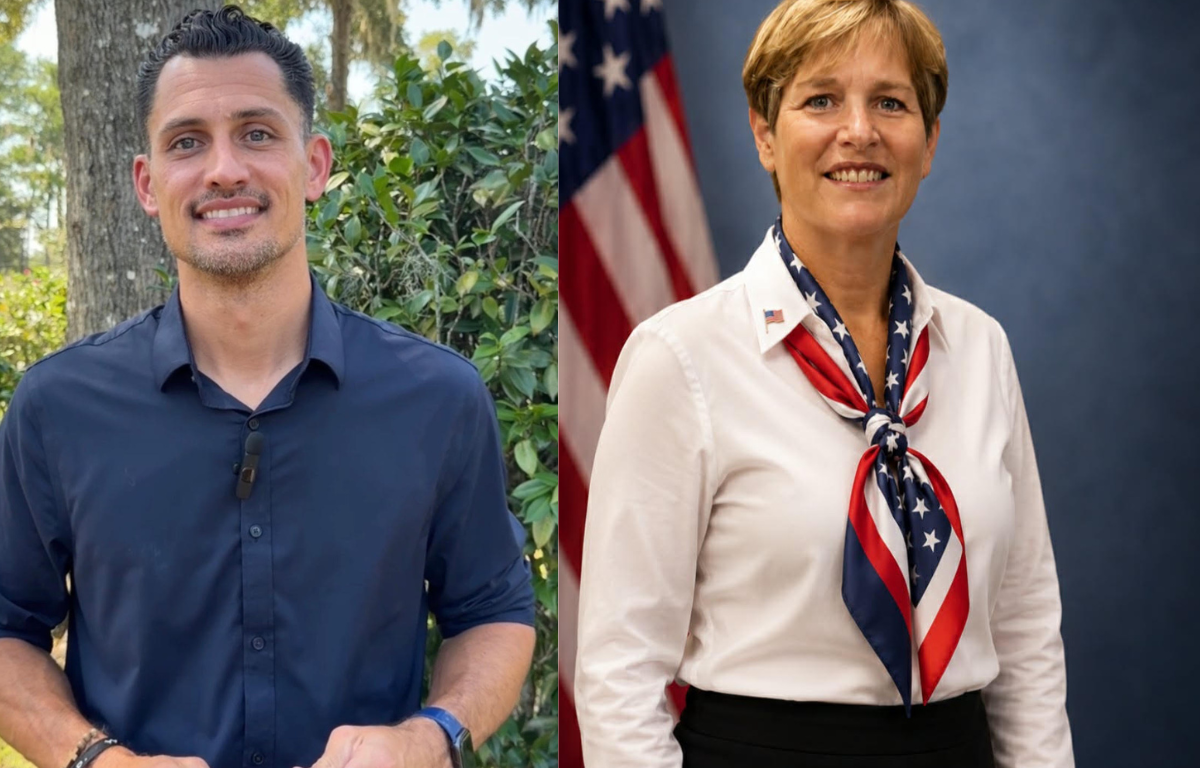

OCALA, FL (352today.com) – Marion County voters will decide the open District 4 school board seat on November 3, 2026, when Mike Mills faces Brigitte Smith in a runoff.
Mills received 23,458 votes (36.86 percent) in the Aug. 18 primary. Smith received 19,631 votes (30.84 percent). Jeff Brewer finished third with 13,445 votes (21.12 percent) and Buddy Wyckoff fourth with 7,114 votes (11.18 percent). Neither of the top vote recipients reached the majority needed to win outright. Incumbent Nancy Thrower did not seek another term.
The nonpartisan race is voted on countywide. Mills, a U.S. Navy veteran and owner of Symmetry Coffee Company in Ocala, is a Take Stock in Children alumnus and mentor and an adjunct professor at the College of Central Florida. Smith is a registered nurse, U.S. Army Nursing Corps veteran, and chairwoman of the Marion County Republican Executive Committee. Her REC term ends in December. She has spent more than a decade in Tallahassee on parental-rights advocacy and volunteers as a medical missionary.
In separate interviews with 352Today, the candidates outlined their positions on students’ reading, the budget, discipline, transportation and growth, contracts, school safety, and what they would put on the agenda first.
Reading, literacy, and who shows up
Florida assigned Marion County Public Schools a “C” for 2025-26. On the 2025-26 Florida Assessment of Student Thinking, 46 percent of Marion County third graders scored at Level 3 or higher in English Language Arts, the state’s mark for reading on grade level, according to results published by the Florida Department of Education.
Both candidates said that is not good enough.
“It’s never good enough,” Mills said. “Until we get to 100 percent of students being able to read at level or above, that’s what we need to be shooting for.”
He said the 46 percent figure comes with gains over the last couple of years, but argued poverty and growth explain why scores remain low. Mills said about 85 percent of Marion students are economically disadvantaged, a condition he tied to higher absenteeism and to children arriving at school hungry.
“A kid who is starving over the weekend or not being well fed over the weekend comes to school on a Monday, and then we expect them to read and write when they’re just really focused on their stomach growling,” Mills said. “I will say that the students being economically disadvantaged and us being in a county that’s one of the fastest-growing counties in the nation, right, not just the state of Florida, has put us in a tough spot.”
Mills said three steps would let teachers “get every kid”: get more children into Voluntary Prekindergarten, get them in the classroom, and get them fed. “We’ll get to 100 percent if we can check those boxes,” Mills said.
He called himself “a physical book guy” over tablet screens and said too much screen time hurts intellectual growth.
Smith framed third grade as an intellectual pivot point.
“After third grade we are learning to read, and then after third grade we are reading to learn,” she said. “I think we can do better, and we need to do better.”
She said documented problems with reading on screens mean the district should “bring books back.” She would spend savings from contract consolidation on early literacy, add mentoring for teachers who need further training, and consider earlier literacy screening.
“I’m going to pound every dollar that I can find into early literacy and helping these students that are behind catch up,” Smith said. “I would love to see one of the north-end schools, which they want to consolidate, turn into a center of excellence in literacy. Because as an OR nurse, we have centers of excellence in the operating room. Why can’t we have these centers of excellence in literacy?”
On absenteeism, Mills said the problem starts in the household and that the district has to pair resources with consequences.
“If the kid’s not getting to class, it’s really hard to learn material when you’re not in the classroom. And if they’re not being held accountable to getting into the classroom, what else are they not being held accountable to?” Mills said.
Smith said she would start with a root-cause conversation with the student and the parent or grandparent, whether the child dislikes school, cannot get there, or lacks basics such as laundry, and then intervene.
“Why are they missing school? Have the conversation with the actual student and the family, whether it be the parent or the grandparent. Is it that they just don’t like school, or is it that they can’t physically get to school, or is it that they don’t have laundry taken care of? Once we find out those issues, then we can intervene and help that student,” Smith said.
For economically disadvantaged families, Mills pointed to his own childhood: growing up in a single-wide trailer, a mother who stayed involved, and then seven years in the Navy as a nuclear machinist, the GI Bill, an MBA, and Take Stock in Children since 2001.
“We come from very little. Just down the street here, there’s a little trailer park. It used to be called Wagon Wheel. We grew up in a single-wide. I use the word ‘dad’ loosely. My mom really kept everything together,” Mills said. “Having grown up the way I did, which is very similar to the 85 percent in Marion County, and then being able to turn that into the life I now get to provide for my kids, I think that’s an example I can live through.”
Smith said those students “deserve every opportunity everybody else gets,” and that communication has to reach grandparents who may not be on a computer.
“We have a lot of programs that help with that. The big thing is to make sure that every parent knows what is available to them, and I think communication is a big issue. Some grandparents are taking care of their children and may not have access to a computer or aren’t as computer-literate as some of the younger folks. We need to consider how those grandparents receive this information,” Smith said.
Budget: what they refuse to cut
Asked which they would refuse to cut among the three options of teacher pay, employee insurance, and class size, Mills declined to pick one.
“I would refuse to cut any of those,” he said. “The last thing we need to take money away from are the teachers.”
He said his businesses taught him to stretch every dollar. “A mentor of mine many years ago told me a dollar saved is a dollar earned.”
Smith also rejected cuts to pay, insurance, and class size. She said the board already raised class size by two students during a shortfall.
“They actually increased the class size. I think last year, two years ago, they had a budget shortfall, and what they did was they increased the class size by two students per classroom. At that board meeting, I do recall them saying they were going to revisit that to reduce the class size. You should not be increasing class size either, because that doesn’t help teachers much,” Smith said. “I would look at other avenues to save money.”
Her target is purchased services. She cited about $8 million in 2025 contracts for speech, hearing, sign language, and physical therapy, plus additional speech-pathologist spending she described for 2026, and compared stacked vendor fees to nursing-agency markups.
“Can we consolidate any of these vendors… without having to pay those agency-fee layers?” she said
Discipline and athletes
Smith’s first word on discipline was “zero tolerance.” She said the Code of Student Conduct is set by the board and by statute but is not enforced the same way from school to school.
“What happens along the way is that it’s not enforced, and it may be different from school to school, so we need consistency. Teachers are supposed to teach,” Smith said.
She would not rewrite the code this year, but she would add to it, including “dress for success,” which she said does not necessarily mean uniforms, and enforce rules already on the books. She said referrals get watered down, and as a result, students learn “rules are optional.”
“Consequences need to be consistent and fair and swift,” she said. “A serious disruption should not get a free pass.”
She wants more adults in hallways and bathrooms through Dads on Duty and volunteer veterans, and a public quarterly discipline dashboard by school so outliers are visible, and deans are trained to the same standard.
“A lot of the chaos starts in the gaps, like in the hallways and bathrooms. With Dads on Duty, we can expand on that. The veterans, too, want to help work that process out. When you have adult figures in all the areas that stand in the gap, that physical presence helps figure this issue out before the issue even arises,” Smith said.
Mills called discipline a community problem. Teachers are “between a rock and a hard place,” he said. “It really takes our community at this stage. We’ve got to get parents resources. The teachers are up against the wall a lot of the time, between a rock and a hard place when it comes to discipline, and I think we’ve got to get parents more involved. The teacher can only do so much inside the classroom.”
Mills believes that administrators should hold parents accountable for absenteeism. On the code, he said many responses are set by the state, but he would “double down on absenteeism” and keep the document under constant audit.
Both said they support zero tolerance for weapons, fighting, and drugs. Mills included “illegal and legal” drugs. Smith’s answer was “zero tolerance. Zero. Zero. Tolerance.”
On a student who repeatedly disrupts class, Mills said one child should not stop dozens of others from learning. He would remove the student sooner rather than later, then pair that with a mentor.
“I am a fan of removing the kid from the classroom sooner rather than later, based on the teacher’s experience. Having said that, that’s not where it stops. Mentorship–so many of our issues as young kids can be resolved with a person, a non-parent in a lot of cases, who can tell you that you’re acting a fool. My mentor did a great job of just saying, ‘Hey, that’s kind of dumb, Mike. That’s not a great choice. Here’s how you can get better.'”
Smith said she wants more structured in-school suspension
“I think we need to have more of a structured in-school suspension, where they are given a book, and they have to read a chapter in the book and write a summary of that chapter. Sometimes these are the kids that need the help the most. If that’s one of the students who need the help the most because they’re failing, we need to have more structured in-school suspension. But if that has failed, then you need to go to the next level and provide an outside program, simply because the student cannot continue to disrupt the class. Every other student that’s in there that wants to learn is not getting the best of their education because you have a disruptor,” she said.
Both said athletes and prominent families follow the same code. “The rules are the rules,” Mills said. Smith said she would hold principals and deans accountable if patterns of preferential treatment appear.
“That does not give them a free pass at all,” she said.
When a student is pulled from class for disorderly conduct, both said it is the student who owns the missed work.
Buses, empty seats, and the next building
Southwest Marion County has added students fast enough that the district opened new schools to ease overcrowding. Several north-end elementary campuses remain well below capacity. 352today previously reported Reddick-Collier had more than 300 empty seats in 2025 and 363 open seats in early 2026. Getting students there on time is still a problem: board members said afternoon buses were on time only about two-thirds of the time earlier this year, on routes that cover a county the size of Rhode Island.
Asked whether he would change routes, start times, or school assignment first before voting for another building, Mills said he would not pick one.
“I think we look at all of them simultaneously,” he said. “We can’t make a Band-Aid decision right now.” He said the school board, City Council, and County Commission have to plan together for continued growth.
Smith said she attended a Wyomina town hall on north-end consolidation. “Longer bus routes are not the answer,” she said. Her granddaughter, she said, does not get off the bus until about 5:25 or 5:30 p.m.
Pressed for an actionable step on late buses, Smith said there is no easy fix. She proposed “small targeted shifts” of 10 to 15 minutes in start times at a few schools so elementary runs can clear before the next tier. She said she knows bells move child care and work schedules.
“Child care and parents’ work schedules move with the school bell. I get that, and it’s very difficult,” Smith said. “Even adjusting 15 minutes affects the family. But parents do adjust to that as well.”
Safe Schools, contracts, donors, and the first 90 days
Smith’s first three agenda items in 90 days: Safe Schools, consolidating contracts, and discipline.
Smith supports moving the Department of Safe Schools under the Marion County Sheriff’s Office. After the Marjory Stoneman Douglas Act, she said, school boards could either create their own safety office or let the sheriff meet the law’s requirements. Marion built its own department. Smith called that another layer of bureaucracy.
“There’s not a better person able to do that than the sheriff for threat assessment analysis,” she said. “Billy Woods was on the record two years ago that he would incorporate Safe Schools into his program.”
Mills’ first agenda fight is keeping the board on the money after a contract is awarded.
“Once we get a big, expensive contract put in place, from what I’ve gathered, there is a disconnect from that point as far as pricing goes. We approve the contract, we award it, and then we are almost pulled away from the financial side of it. I think it is critical that we are involved in the financing and accounting all the way through. I don’t want the facilities department, the engineering department, to be fully and exclusively relied upon to overlook the books and the pricing. I want visibility. I want to see if this item looks like it shouldn’t cost what it costs. I want to be able to audit that constantly,” Mills said.
His second item is expanding mentorship so adults in the community can help students who are behind, and, he said, fill “that lack of fatherhood, lack of motherhood.”
Asked who wrote the biggest checks and what donors get, Mills said gifts come from many industries at $500 and $1,000. According to Mills, if anyone, “my mother included,” asked for a favor, he said he would refund the money and end the relationship.
“I’m not beholden to anybody on this side of glory,” he said.
Smith said two supporters she has known for years each wrote $1,000 checks, and she had nearly 100 donors from $10 up. What they get, she said, is “a school board member that’s going to advocate for our students, their taxpayers, and our teachers and families.”
In terms of a vote they would recuse themselves from, neither named one. Mills joked that a vote to put coffee shops in every school might force him off the dais because he owns one. Smith said she could not think of a business, family, or professional tie that would keep her off a vote; her REC chairmanship ends in December.
Closing appeals
Mills said he is “not an aspiring politician” but “a frustrated father.” He grew up with little, served, built businesses, and wants the evidence behind campaign claims.
“I’m not an aspiring politician. This is the last thing I thought I would ever do. I am a frustrated father who wants to see kids have more opportunities in a world where I feel like they’re shrinking a little bit, and I’m committed to that,” Mills said.
“Being in the political space and stepping into this, one thing that I am learning is that there is a lot of talk. There are a lot of things said, and I think the substance and the evidence of it is really important, because it’s super simple to say, ‘This is wrong, and I know how to do better.’ It’s another thing entirely to say, ‘I think this is wrong, and here’s the evidence as to how I’ve corrected things like it in the past.’ I love education. It’s easy to say that. Where’s the evidence that you’ve been involved in education beyond the classroom? When people look into who they want to vote for, don’t look at the claims. Look at the evidence that supports the claims,” Mills said.
Smith said she did not wake up this cycle and decide to run. “I’ve been in this arena for over a decade. I have been advocating for parental rights for over a decade, traveling back and forth to Tallahassee. I’ve done this for the last decade, so I just didn’t wake up and want to do this.”
She called literacy “the foundation to everything else.” “I believe every child deserves a chance to not just get by, but truly thrive, and I’m running to bring this reading revolution to our schools. Literacy is the foundation to everything else. When kids learn to read early and well, they can unlock their full potential and build a stronger future for the whole community.
She also wants the district’s LPN-to-RN bridge expanded so high-school students get clinical time in local hospitals, not only classroom hours.
“The school board just this past year, they are creating the LPN-to-RN bridge, and I would love to see that expanded with career technical, where we can further implement the clinical portion of that,” Smith said. “If high school students know they want to become a nurse, they really get themselves involved early with the hospital in our area.”
The general election is November 3, 2026. Information on voting is at votemarion.gov.