


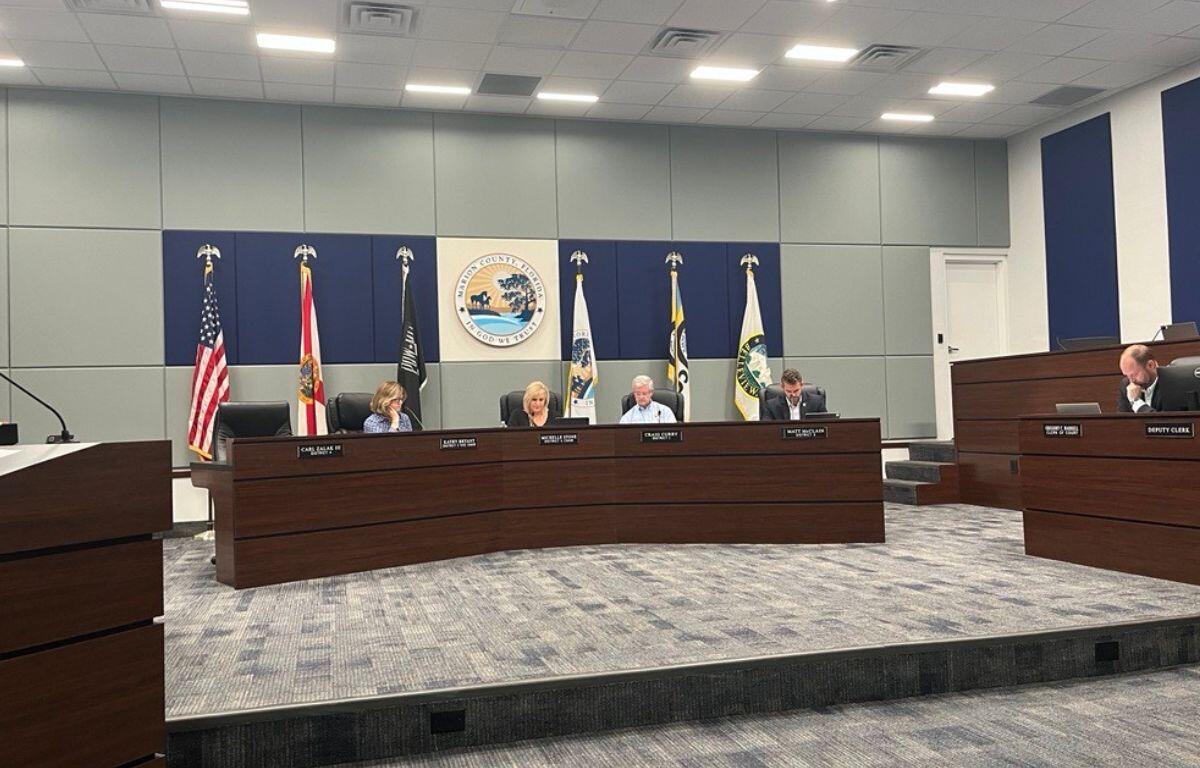

OCALA, FL (352today.com) – On Thursday, Marion County commissioners tentatively raised the countywide property-tax rate after cutting it last year with leftover federal stimulus money, adopting a $1.73 billion spending plan built largely around public-safety payroll.
The September 10, 2026 hearing at the McPherson Governmental Campus was the first of two required votes. Final adoption is scheduled for 6 p.m. Sept. 24 in the Commission Chambers.
The board set the combined countywide millage at 4.28, up from 4.02 this year. The general-fund rate, the levy that actually moved, would go from 3.09 mills to 3.35 mills. Commissioners had started the summer looking at 3.49.
“I know when we started this process, the millage rate was originally proposed at 3.49, and after two months of working through it and going through each item line by line, dwindling it down, we were able to come down to 3.35, which is where we would have been last year had we not brought the millage rate down with the excess funds that we had from the ARPA funds,” Commissioner Kathy Bryant said.
ARPA is the American Rescue Plan Act, the 2021 federal COVID-relief law that sent one-time money to local governments; Marion County used leftover ARPA dollars last year to temporarily lower the general-fund millage to 3.09. A “mill” is $1 of tax for every $1,000 of taxable value.
Marion County Budget Director, Audrey Fowler, broke down the increases.
“The specific purposes for the tax increase in the general fund is an increase in ambulance services personnel expenditures of $12,037,964 and the Sheriff’s jail operations of $6,769,904 for personnel and operating expenses. In the fine and forfeiture fund, the increases in the Sheriff’s regular operations of $1,533,072, the bailiff operations of $736,338, and the Florida Department of Juvenile Justice payments of $331,293. Finally, the Health Unit Trust Fund increase is an increase in capital improvements in the amount of $948,101 for the construction of a new health department facility,” Fowler explained.
Unincorporated residents also pay separate Municipal Service Taxing Unit (MSTU) rates that the board left unchanged: 3.72 mills for law enforcement and 1.11 mills for fire-rescue. In Marion County, “unincorporated” means you live in the county but not inside Ocala, Belleview, Dunnellon, or McIntosh. You still get a county tax bill, and you also pay the extra sheriff and fire MSTU rates that city residents generally do not. Those rates are still above the state’s “rollback” figures because property values rose. Fowler said the law-enforcement MSTU needs $11.9 million more for sheriff operations, and the fire-rescue fund needs $19.1 million more for personnel.
A table in the clerk’s hearing packet estimated that an average unincorporated single-family home would pay $113 more next year across the countywide, law-enforcement, and fire levies. An average homestead would pay $93 more.
Property Appraiser Jimmy Cowan attended with staff and reminded the room that his office sets values and exemptions, not the millage rates on the second half of the tax bill. He said appraisers were standing by in the lobby for anyone with questions about market value, Save Our Homes, agricultural classification, or exemptions.
“We’ve got people staffed at our office tonight. So if there’s anybody here that needs to look at value, exemptions, things of that nature,” Cowan said. “Our office is open and staffed. We have commercial appraisers, ag appraisers, tangible appraisers, and real estate appraisers. So there’s people waiting right now.”
The tentative countywide budget is $1.17 billion. Non-countywide funds, MSTUs, utilities, impact fees and neighborhood assessment districts add $562 million. About $253 million of the countywide total is infrastructure-surtax construction, much of it roads. Other large items include solid waste, a hospital Medicaid pass-through, and the last of the county’s American Rescue Plan money.
All votes were unanimous.
The only resident to speak was Joe Payne. Payne said their neighborhood sits in a pocket that requires deputies and ambulances to leave the county on State Road 42, go north on U.S. 19, and come back in on Ravenswood Road. She said law-enforcement calls take 20 to 25 minutes and that EMS response is “way beyond the national average, like three times.” Six elderly neighbors near her property have died in the past five years, she said. She is about four miles from Lake County’s Altoona fire station and does not know what mutual-aid coverage exists.
Payne also said deputies coming from Ocklawaha will not write tickets for ATVs crossing his land unless they witness it, and that no one routinely patrols far enough to get there in time. She asked why remote residents pay the same rate for slower service and suggested a separate, lower-tax district.
“Why should we pay the same taxes as everybody else in the county when we’re not getting the same service?” she asked the board.
Commission Chair Carl Zalak, III did not debate the point. After the fire millage passed, he asked the Fire Chief for Marion County, James Banta, to meet Payne after the hearing to explain the county’s mutual-aid agreement with Lake County.
Residents can still ask the board to lower the rates on Sept. 24 at the final public hearing for the adoption of all the millage rates. State law does not allow the commission to raise them above the figures adopted at the Sept. 10 meeting.