


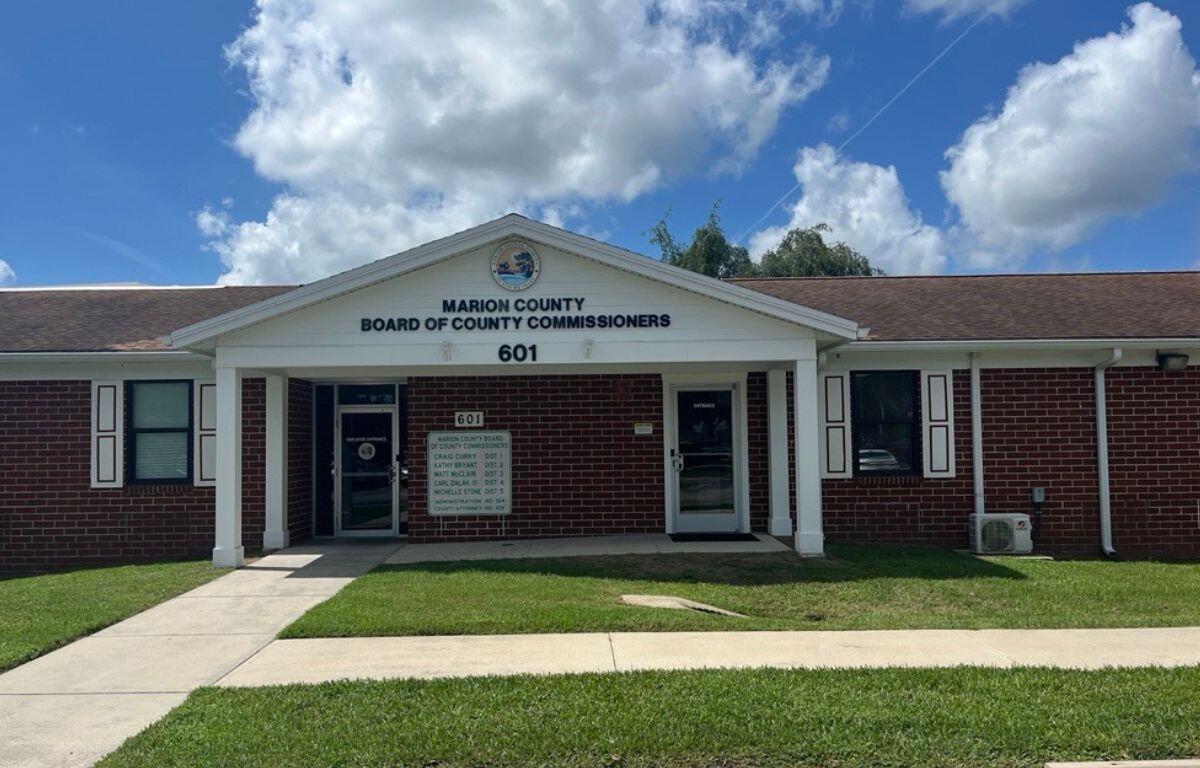

OCALA, FL (352today.com) – Marion County commissioners voted Tuesday to approve a 12-month moratorium on new applications for large commercial data centers using 50 megawatts or more at maximum electric demand.
The ordinance, taken up in the planning and zoning portion of the September 15, 2026, Board of County Commissioners meeting, puts a temporary hold on accepting, reviewing, or approving rezonings, special-use permits, site plans, development permits, and building permits for large commercial data-center facilities in the unincorporated county. The freeze lasts 12 months from the effective date, or until the county adopts new land-development or comprehensive-plan rules, whichever comes first.
The board first voted 4-1 to approve a one-year freeze that applies to large commercial data centers expected to use 50 megawatts of electricity or more at peak demand. Commissioner Kathy Bryant voted no because she wanted smaller plants included in the freeze too. The board then voted 5-0 to adopt that ordinance as official county law.
Chair Carl Zalak, III stated the official scope on September 16, 2026, by sharing a reel on Facebook.
“You may be wondering about data centers in our community,” Zalak said. “During this week’s board meeting, we passed a 12-month moratorium on commercial data centers. So, who does this apply to? It pauses large commercial facilities that have an anticipated peak load of 50 megawatts. Some examples would include AI computing hubs or crypto mining facilities, while keeping standard IT for local businesses, schools, and hospitals exempt.”
The next date, he said, is a board workshop on Monday, Sept. 21, at 2 p.m. “Why are we doing this? To set clear rules before formal applications are filed. Under Florida’s new Senate Bill 484, local zoning authority stays in our community’s hands.” Staff is to work on performance standards for “noise limits, grid capacity, buffer setbacks, and, of course, our water and springs,” Zalak said.
That list tracks the ordinance. Section 5 of the moratorium ordinance, titled “Study and Evaluation,” orders staff to study Florida Aquifer withdrawals, water and wastewater capacity, electrical infrastructure, land-use compatibility, Outstanding Florida Springs and springsheds, and cooling practices recommended by the water management districts, including reclaimed water and closed-loop or air-cooled systems.
Chief Assistant County Attorney Dana Olesky opened the hearing by saying the current code was not written for this use.
“Data centers are a rapidly growing and evolving land use that typically requires substantial electricity and water usage for cooling and related operations, often generating a significant amount of noise and can take up a large amount of land,” she said. “Existing ordinances and development standards do not adequately address the unique infrastructure demands, impacts to neighboring property owners, and operational characteristics of newer data centers. Additionally, potential cumulative impacts of data centers on the county’s water and wastewater systems, groundwater resources, and electrical grid are not yet fully understood.”
Planning and Zoning had recommended the ordinance 6-0 on Aug. 31, she said, but that version had “a pretty broad definition of data center with no exemptions.” Exemptions for government, schools, hospitals, and telecommunications were added afterward so the county’s own servers, a 911 expansion, or a hospital IT room would not be caught in the freeze.
Olesky then warned those carve-outs still left staff exposed.
“I am concerned that allowing any exemption really puts us in the same position of we just don’t have the right regulations right now, or maybe we do, and we just don’t know it yet,” she said. “If a special use permit application came through today, I don’t know that staff would have all the right questions and answers for those applications if they were to present it to you.”
County Attorney Matthew Minter asked that noise be added to the study list and that special-use permits be named in the freeze. Olesky agreed.
After public comment, the argument was not whether to pause. It was where to draw the line.
Senate Bill 484, which took effect July 1, 2026, leaves local zoning in local hands and treats a “large-load customer” as a user with an anticipated monthly peak load of 50 megawatts or more, measured as the highest average load over a 15-minute interval. Plants under that mark are not exempt from local rules. They are simply not in that statutory class. That is the line Zalak, McClain, Curry, and Stone used: freeze the big commercial files, leave smaller plants and internal IT on the existing special-use track, and use the year and the Sept. 21 workshop to write the questions before a live application lands.
Commissioner Matt McClain said the target is hyperscale. “I think the big concern is these really large hyperscale centers. That’s always been the concern. I don’t think it’s the smaller ones; we can figure those out through the special use permit process,” he said. “I want to make sure that we don’t get any big applications from the big hyperscalers.”
Bryant said the exemption still lets through a plant that behaves like a small city. “A 49-megawatt facility is a 100,000 to 200,000-square-foot data center. That is the equivalent of 10,000 to 15,000 households,” she said. “My issue that I am having a hard time with is the exemptions that we put in there. I don’t think that should be in there, quite frankly.” She also said staff has already stated it does not have the criteria or the right questions yet.
Commissioner Craig Curry said six months is not enough. “I don’t think six months is adequate for staff to do their research,” he said. “I think it’s been pretty well accepted out in the public that 12 months is kind of what we’re after here today.”
Residents speak out
Jack Pritchard of Summerfield asked the board not to freeze the county out of the industry.
“I’m here to express my support in responsible development of data centers in Marion County,” Pritchard said. “Data centers are becoming an essential part of America’s future. Almost everything we do today depends on digital technology.”
“The question isn’t whether America will need more data centers; we will. The question is whether communities like Marion County will help lead the future and benefit from the jobs and investments and infrastructure and the economic growth that come with it.”
He said modern plants can use closed-loop cooling that “greatly reduce the water consumption,” and that commissioners should not “allow fear of technology to prevent Marion County from participating in America’s future.” After the chair called time, he added that wastewater from the county plant “could be pumped as much as twenty miles and recirculated and not have a water issue.”
Sheila Brannon of Dunnellon supported the year and a longer pause if staff is still not ready.
“I am for the moratorium, and I think, you know, 12 months isn’t really all that long. And if the staff, the county can’t come up with everything they need, well, extend it for another three to six months.”
Brannon said traveling construction crews, not local hires, often build these plants, and that the permanent payroll is thin. Small facilities, she said, typically mean “one to five permanent jobs.” A medium plant, “five to twenty.” Hyperscale campuses can run higher, she said, “but I don’t think Marion County could handle that. I don’t think we have the assets for that.”
Renee Andrews of Shiloh, a fifth-generation resident near Northwest Highway 320, asked the board to use the year to write water and power rules.
“I support the proposal to pass an ordinance to impose a moratorium on data centers because they use a great deal of water for cooling and massive quantities of electricity, which will strain our existing grid, and they’re also quite noisy,” Andrews said. “Groundwater conservation is extremely important. We’re having a drought now, and there will undoubtedly be more droughts in the future. I think a permanent moratorium would be ideal, but a moratorium of at least a year is a great idea because that’d give Marion County time to develop rules that a data center would have to abide by, such as recycling water as opposed to pumping potable water from the aquifer, and paying to upgrade the electric grid. There are many other land uses that are more compatible with our life here in Marion County.”
What happens next
The ordinance is not a permanent ban. It stops large commercial computing plants, 50 megawatts and up, in unincorporated Marion County. A school server room, a hospital IT shop, and a smaller commercial facility under that threshold can still be reviewed as a special-use permit, which is not approval by right.
During the year, growth services staff and the Land Development Regulation Commission are to study aquifer withdrawals, grid demand, cooling technology, noise, setbacks, and spring protection, then bring draft standards back through workshops and public hearings.
The first of those dates is Monday, Sept. 21, 2 p.m., McPherson Governmental Campus Auditorium. Marion County Commissioner meeting details, including agendas, can be found here.