


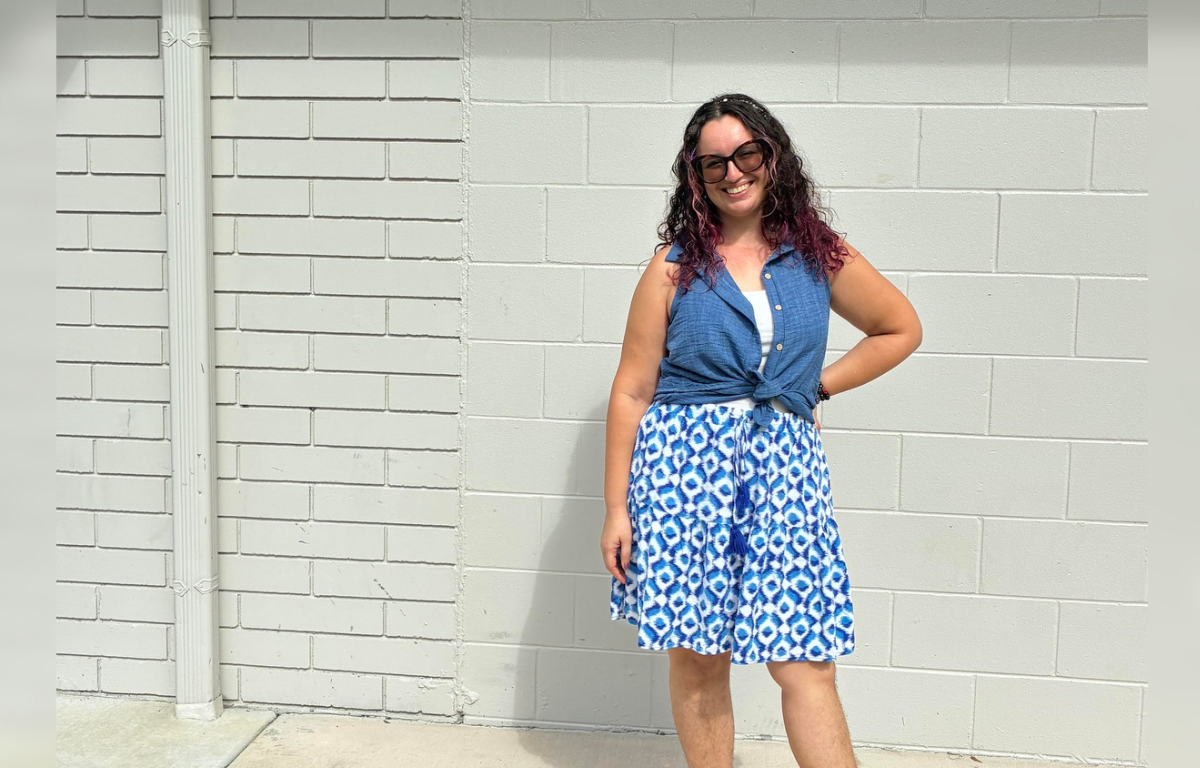

OCALA, FL (352Today.com) – For some people, successful physical therapy happens in a clinic. For Esmee Bancroft, it happened while sorting piles of donated clothes.
Bancroft, founder and CEO of Resilient Ocala, formerly known as the Ocala Clothing Swap, developed an autoimmune condition that caused her nerves to stop communicating with her muscles. The resulting paralysis came in waves. At times, she used a walker. Later, she needed a wheelchair. Eventually, she required a power wheelchair just to move around her own home and get herself to the bathroom.
“Soon after we discovered the autoimmune condition and started treating it, I started rebuilding strength,” she said. “And I used Ocala Clothing Swap, sorting the clothing as my PT. Like, they have you do rainbows all the time to build strength, and that’s looking at clothing and putting it in a pile, lifting the bags of donations.”
She described the “rainbows” as the motion of lifting clothes and arcing them over to the other side, a sweeping movement physical therapists use to rebuild strength.
She went from holding only a pound or two of clothing to lifting totes weighing nearly 50 pounds. “So I used it as my PT and my occupational therapy,” Bancroft said.
That personal recovery helped crystallize something larger. What began as a peer-support clothing swap has expanded into Resilient Ocala Incorporated. This nonprofit now operates both a free clothing boutique and a peer-support clubhouse modeled on the International Clubhouse Model. Members are not just recipients of services; they help run the organization.
“It’s welcoming in people that otherwise wouldn’t have opportunities to lead, to have ownership over things, to be able to share ideas and see it come to life,” Bancroft said. “They get that independence, they get that wraparound support, and it’s based on peer support, which is a style of mental health support where it’s non-clinical. It’s people who have lived experience talking to each other, and that lived experience is where that healing occurs.”
The free clothing boutique still serves about 200 households a month and has diverted roughly 20,000 pounds of textiles from the landfill in the past year, according to Bancroft. Since September, when the clubhouse began operating on partial hours, an average day brings 10 to 20 people into the space. Larger outreach events have drawn as many as 250.
A typical day starts at 10 a.m. with what Bancroft calls “administrative tasks” that emphasize executive functions: critical thinking, planning, and money management. On Mondays, members pull out composition books and write out the previous week’s expenses. One member recently spotted a fraudulent charge on his credit card because the group had already talked through what to do.
“We’ve already caught a fraudulent charge that was on one of our members’ credit cards, and without any prompting, he was like, ‘I know exactly what to do because we’ve talked about it now.’ So, to see that change in people, that is the executive function time too,” Bancroft said. “The 10 a.m. to 1 p.m. time frame. So tasks that require a lot of thought, critical thinking, a lot of logic, those are the tasks we do in the morning. Things that are very prefrontal cortex.”
She sits with every person who comes through the space, whether volunteer or member, at least once a week. They talk about the struggles of that particular week and about longer-term goals. One member is saving to buy a nice watch for himself. They check in on progress, including the small daily choices that can derail a plan, such as impulse purchases. Bancroft described talking through the nature of impulse buying and how she guides that conversation without shaming the person.
“How are you doing on that? How are you doing? Like when you go to Dollar Tree, are you getting more than you set your goal to?” Bancroft said. “And talking like, ‘That’s a very real thing to have.’ We make those impulsive purchases all the time.”
The same approach extends to daily living skills. Shared meals are prepared with ingredients that can be purchased using food stamps and cooked on appliances that plug into the wall, such as an Instant Pot, air fryer, or panini press, because those tools are often more accessible for people with physical, mental, or intellectual disabilities, according to Bancroft. The goal is both modeling and hands-on practice.
“We use ingredients that you can buy using food stamps, and we cook all of our meals with things that plug into the wall… Because these are sometimes more accessible,” she said. “Showing them how they can do that on their own, modeling it, but also… Show one, teach one, do one, or show one, do one, teach one.”
Shared lunch itself is part of the work. Bancroft described it as a healing experience for people who are often isolated and rarely share meals with others. “That shared lunch is a healing experience because there’s all ages represented at the table, and we’re able to have these conversations that a lot of people with disabilities [don’t have], and are so isolated, they aren’t having shared meals, and that provides healing and anchoring and connection that allows us to, even though we all have our own things and our own triggers, we’re able to work together.”
Afternoons shift to wellness activities such as art, movement, mindfulness, and music, deliberately drawn from the kinds of adjunct therapies offered in clinical settings. Throughout the day, the free clothing boutique continues: Donations are accepted and sorted, shoppers are greeted, and the inventory has expanded to include hygiene items, adult briefs, books, and children’s toys.
People often arrive first as shoppers. Bancroft’s openness about her own physical and mental health conditions tends to lower the barrier for others. She has become the first person some visitors have told about abuse or assault, she said, because the conversation starts from a place of removing shame.
“I am only there to love and serve them in that moment,” she said. “And that is that wraparound, so they feel held, and it allows people to share things that they otherwise wouldn’t. And then that’s where I’m able to be like, ‘These are resources I know.’ These are other nonprofits that you can tap into… But also, anytime you need it, you come here. You belong here.”
Outcomes have included vocational progress. Almost every member of the original founding board of the clothing swap, many of whom had life-limiting disabilities and no prior nonprofit experience, has since found gainful employment. Bancroft has also seen reduced isolation, improved ability to communicate with doctors, and several cases in which early intervention through the group helped prevent mental health hospitalizations.
“We have seen a bunch of wraparounds that have prevented hospitalizations, especially mental health hospitalizations,” she said. “So being able to catch people and notice those warning signs early on, and be able to, like, say, ‘Hey, something’s going on here, and I’m worried about you,’ and getting them tapped into resources before it gets to a point of an involuntary psychiatric stay.”
She defines wraparound support as looking beyond a single issue. Rather than asking only how anxiety is affecting someone’s ability to work, the approach considers how it touches relationships, finances, and other areas of wellness.
“Wraparound is so instead of just looking singularly at one thing… It’s looking at how it impacts your relationships, your finances, all of these different areas of wellness,” Bancroft said. “There’s eight areas of wellness… You need to be addressing all of them to be able to get someone back to a healthy, stable, and resilient state.”
She chose the name Resilient because of both individual and community meanings of the word. Drawing on concepts her mother taught while training home visitors for programs like Healthy Start, Bancroft focuses on protective factors: the relationships, skills, and structures that help people bounce back from hardship rather than cycling into homelessness or the justice system.
“Resilience is both. It’s being hard and soft at the same time, and it’s our ability to bounce back,” she said. “So everyone’s going to go through hardships in their life, but for some people, it takes away so much stability for them that they have a hard time getting back. They end up going back into the prison system. They end up going back into homelessness, and so I wanted to find ways to increase that resilience.”
Resilient Ocala does not diagnose or prescribe. It offers a non-clinical, peer-support space for people who need more than a monthly medication appointment or weekly therapy session but do not meet the threshold for inpatient or intensive outpatient care.
“We are not talking clinical. We’re not trying to. We don’t prescribe. We don’t diagnose,” Bancroft said. “We are just there with the people struggling, and it gives them a place to go when they’re having the hard days that they need a little extra support, but they don’t qualify to go inpatient… Therapy and a once-a-month med management appointment is not enough for them, and that’s the magic of the clubhouse. It provides that.”
The organization will hold a free clothing boutique on Saturday, Nov. 7, from 12 to 3 p.m. at its location at 2324 NE 8th Road. The event is open to the public and will include clothing, toys, and other items. On Nov. 18 the organization will also host the Ocala Plant Swap in its developing community garden.
“Anytime you need it, you come here,” Bancroft said. “You belong here.”
More information is available on the Facebook event page.