


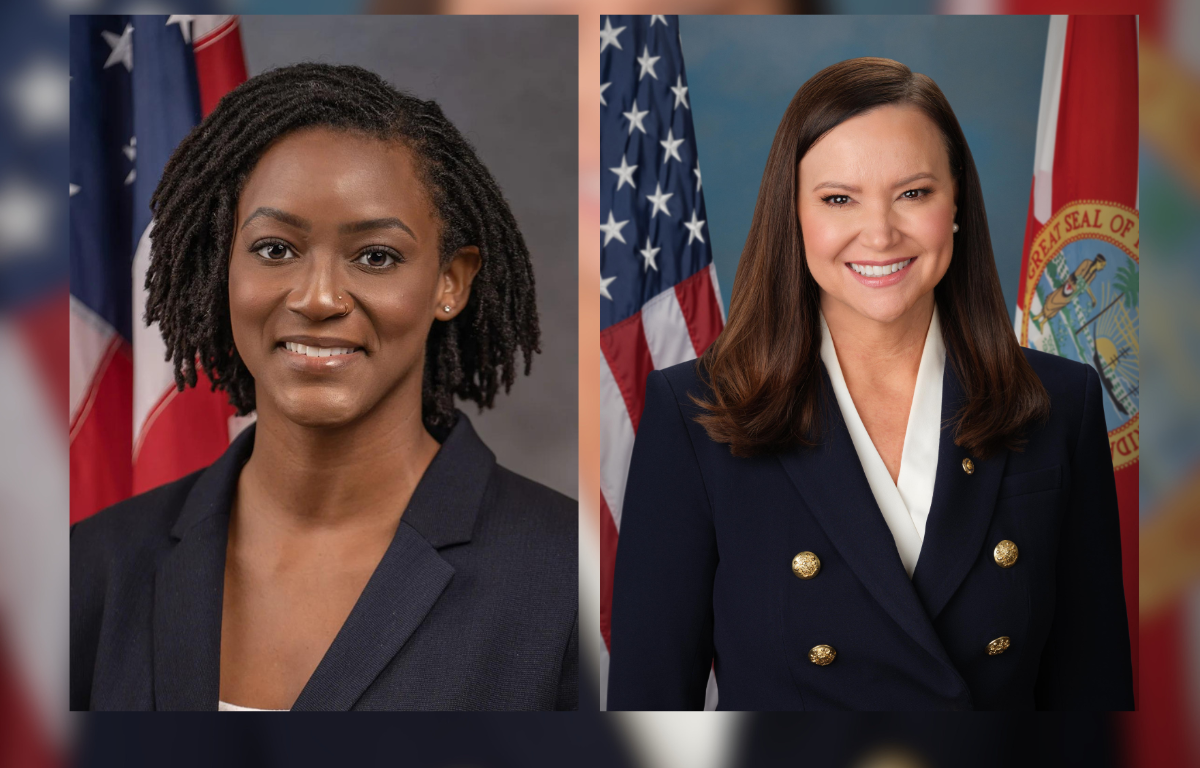

OCALA, FL (352Today.com) – Republican Sen. Ashley Moody and Democratic state Rep. Angie Nixon are headed for a Nov. 3 special election to finish Marco Rubio’s term, and the two candidates have about as much in common as apples and oranges.
Who they are
Moody’s pitch is experience and continuity. She’s the former AG who sued over voter rolls and consumer issues, the judge who rose through the system, and the senator who has stayed close to Trump’s agenda. Her campaign treats the race as a clear choice between her record and what she calls “Nixon’s brand of big-government politics.”
Nixon’s pitch is that the system isn’t working for regular people. She talks about high rents, expensive insurance, and medical bills, and she has a history of protest, including getting arrested during a sit-in over Florida’s congressional maps. She joined the Democratic Socialists of America last year but has said she doesn’t sign on to every part of their platform. She has described herself as “a capitalist who believes that we need some strong regulation.” If she wins, she’d be Florida’s first Black U.S. senator.
Both are University of Florida graduates, but their paths diverged from there.
Moody, a Plant City native, earned a bachelor’s and master’s in accounting from UF, a law degree from the UF Levin College of Law, and later an LL.M. (Legum Magister) in international law from Stetson University; she served as president of Florida Blue Key while at UF. She began in commercial litigation at Holland & Knight, became a federal prosecutor handling drug, firearm, and fraud cases, and in 2006 was elected the youngest circuit judge in Florida (Hillsborough County’s 13th Judicial Circuit), where she served until she resigned in 2017 to run for attorney general. She held that office from 2019 to 2025 before her Senate appointment.
Nixon, raised in Jacksonville’s Moncrief neighborhood, graduated from Stanton College Preparatory School and earned a B.A. in political science from UF in 2007. Public records do not list either candidate’s college GPA. After graduation, she ran unsuccessfully for Jacksonville City Council in 2008, worked as a legislative aide to state Rep. Mia Jones, and spent years as a community and union organizer, including roles with the New Florida Majority, SEIU Florida, and the Florida Public Services Union’s higher-education campaign, while co-founding local markets and a bookstore/cafe called “Cafe Resistance.” She has served in the Florida House since 2020.
Nixon joined the Democratic Socialists of America in June 2026. The DSA describes itself as a democratic socialist organization that wants the economy and major institutions controlled by workers and communities rather than by corporations and the wealthy. Its platform calls for Medicare for All with no premiums or copays, a Green New Deal, strong unions and a higher minimum wage, housing as a human right (including rent control and large-scale public housing), ending mass incarceration and substantially reducing or abolishing police in their current form, open borders and an end to mass deportation, progressive taxation including wealth taxes on billionaires, free public college and cancellation of student debt, and a foreign policy that prioritizes diplomacy over military intervention and opposes unconditional aid to allies such as Israel.
Moody’s positions are the opposite on nearly every one of those points. She has framed the race as a choice between “freedom or socialism,” arguing that expanding government control of the economy has failed wherever it has been tried and leads to less individual freedom. She supports market-based healthcare fixes focused on fraud reduction and competition rather than a single public plan, backs Republican tax cuts (including no tax on tips) instead of new wealth taxes, emphasizes border security and law enforcement over reduced immigration enforcement or open-border policies, and has defended traditional policing and incarceration as necessary for public safety. On foreign policy, she has aligned with Trump administration priorities, including support for stronger sanctions on Cuba and backing U.S. military actions, rather than the DSA’s preference for reduced intervention and conditioned aid.
Where they really split
Healthcare
Nixon wants Medicare for All with one public plan for everyone, no premiums, no deductibles, no copays, and coverage that includes dental, vision, and mental health. She says she’d start by restoring the enhanced Affordable Care Act subsidies and rolling back the Medicaid cuts in last year’s big Republican spending bill.
Moody hasn’t put out a sweeping plan. She talks about cracking down on Medicaid fraud, speeding up cheaper generic drugs, and looking harder at hospital billing. She voted against extending those ACA subsidies and supported the spending bill that independent analysts say will reduce federal Medicaid funding over time.
Cost of living and housing
On affordability and the economy, the two candidates offer sharply different fixes. Nixon’s plan centers on direct government intervention: she wants federal action against corporate price-gouging on groceries, fuel, and other essentials; a national rent freeze and eviction moratorium; large-scale public investment in affordable housing; free childcare and paid family leave; and a 5% annual wealth tax on billionaires to help pay for it. She argues that monopolies and corporate consolidation are driving up everyday costs and that stricter rules plus expanded public programs are needed to bring prices down for working families.
Moody’s approach relies on tax cuts and market incentives. She highlights Republican-led measures such as no tax on tips, new child investment accounts for newborns, and legislation aimed at shielding ratepayers from utility cost increases tied to data centers. She says these steps put more money back in people’s pockets and that Democratic opposition has blocked similar efforts to make life more affordable.
Immigration and safety
Nixon has criticized mass deportations and large detention facilities (she’s called some of them inhumane) and said ICE doesn’t need to operate the way it currently does. She still says the border should be enforced, but she wants less emphasis on incarceration and more on treatment for drug issues.
Moody’s record and campaign are built around border security, supporting law enforcement, and making sure only citizens vote. As attorney general, she pushed to clean voter rolls; in the Senate, she’s backed stricter ID rules under the Save America Act.
How big a role government should play
This is the sharpest contrast. Moody frames the choice as “freedom or socialism,” pointing to Nixon’s DSA membership and warning that bigger government has failed elsewhere. Nixon rejects the socialist label on the campaign trail. She says she just wants government to work for working people instead of corporations, fully fund public schools (and stop diverting money to private vouchers), and get big money out of politics.
Voting rules
Moody has long argued that non-citizens are getting on the rolls and wants tighter verification. She defended Florida’s Republican-drawn congressional maps as a response to population growth.
Nixon has called those maps gerrymandered and accused state Republicans of suppressing votes since 2018. She says she’d fight the Save America Act because she sees it as making it harder for eligible people to vote.
The bottom line
Both candidates say they’re focused on what Floridians pay for housing, healthcare, and everyday life. They just diagnose the problem and the fix, in almost opposite ways. Moody leans on her years inside the system and on Republican tax and border policies. Nixon leans on organizing, protest, and a platform of expanded public programs paid for by higher taxes on the wealthy and corporations. The winner serves through early 2029.