


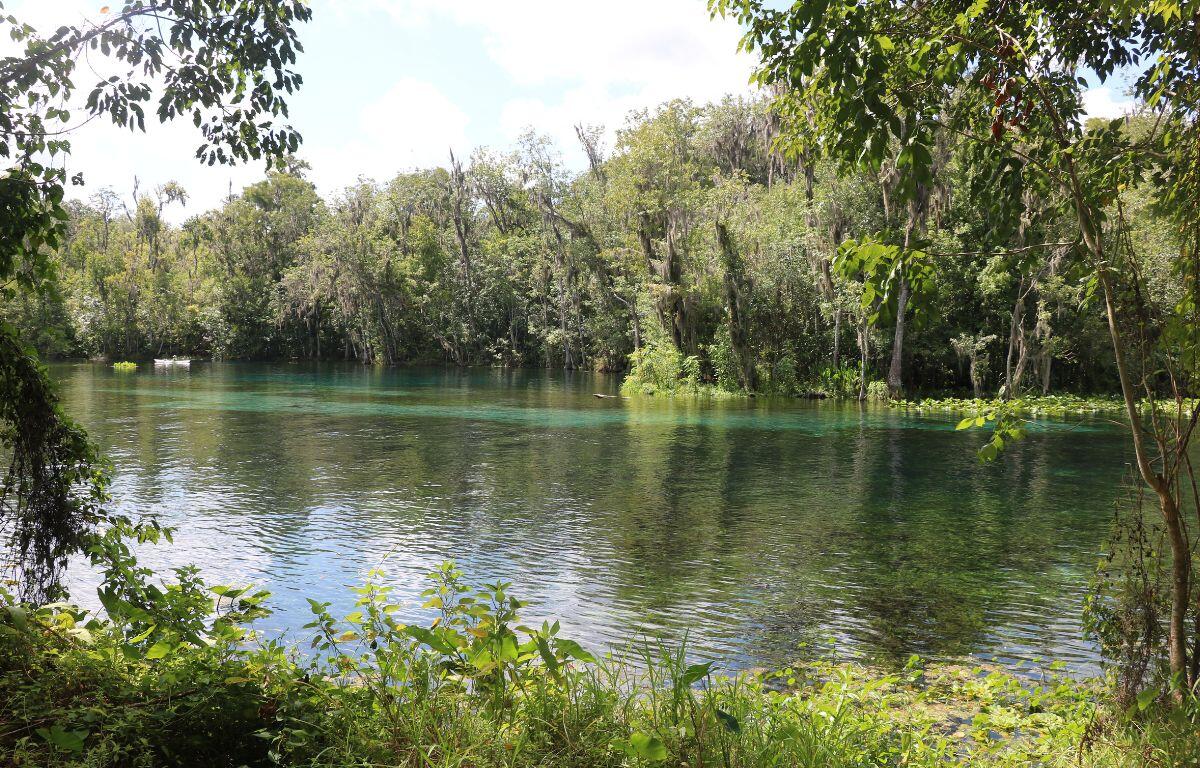

HIGH SPRINGS, FL (352today.com) – Robert “Bob” Knight did his doctoral research on Silver Springs in the 1970s. He came back to springs science in 2002, when the St. Johns River Water Management District hired him to study flow reductions and pollution at Blue Spring. What he saw there, he said, was a spring already in decline. State agencies then sent him across Florida. Every spring he measured, he said, was losing flow.
“I immediately saw that spring flows had declined a lot at that spring, and then I got hired to study springs all over the state by state agencies, and every one of the springs has got declining flows,” Knight said.
He does not treat that as a mystery. People, he said, are pumping three to four billion gallons a day from the Floridan aquifer on an average year, more in a dry year, when lawns and farms take extra. Average recharge, in his telling, is roughly 10 billion gallons a day. “We’re pumping more than a third of our average income,” he said. “It’s like having a bank account, and you got money coming in from some investment, and you start spending more than is coming in. What happens? Your account balance goes down.”
That balance sheet is no longer abstract at Poe Springs.
Alachua County closed the swimming area at Poe Springs Park on July 16, 2026, after water clarity collapsed. Researchers with the Florida Springs Institute, which Knight founded in 2010, tested the pool the same week and found it stagnant, with an algae bloom. Officials said conditions will not improve until enough groundwater returns to recharge the vent. Picnic grounds, trails, and the boat ramp stayed open. The swimming hole did not.
This has happened at Poe before. Knight said the spring and several others on the Santa Fe River stopped flowing in the 2011-12 drought. They have done it again.
“The only way for water to start flowing out of springs again is for the aquifer levels to come up, and the aquifer levels come up when it rains,” Knight said. Rain this summer has not been enough, he said, because pumping never stopped. Poe’s historic average flow, before the 1980s, was about 40 million gallons a day. “It’s a fraction of that now. It’s less than half of that now.” When a spring is already running that low, he said, add more pumping and a two-year rainfall deficit and “of course the spring is going to stop flowing.”
Ocala draws from the same Floridan aquifer.
Knight’s first field notes were taken at Silver Springs, Marion County’s first-magnitude spring and the aquifer’s most famous window in this part of the state. The city, he said, is not a bystander in the withdrawals that lower that water table.
“The big permits take most of the water,” Knight said. “The really big, big farms, the cities, Ocala takes a tremendous amount of water. A lot of which is put on the ground watering people’s plants.”
Gainesville, High Springs, Alachua and Newberry, he said, are the withdrawals that hit Poe hardest. Ocala’s share shows up at Silver Springs and in the regional Floridan system that feeds both counties. Knight’s image for the whole map is blunt: one Slurpee cup, more than a million straws.
“We have a single one as a Slurpee cup, and we’ve got a million straws, 1,020,000 straws in the same cup pumping water out of the same resource, the Florida aquifer,” he said. “That’s where we’re all getting our water, including the springs.”
Those straws, in his count, include about 20,000 large permits of more than 100,000 gallons a day across the four springs-region water management districts, plus nearly a million private wells. Lower Santa Fe springs are still flowing, he said. That is not proof the system is healthy. “We haven’t pulled it down enough to stop them yet. But it’s happened in the past, and it could happen yet.”
He is pessimistic that homeowners can fix it by shortening showers. Individual conservation helps, he said, but it will not refill a spring while the large users keep their allocations.
“There’s nothing that individuals can do about it. They can stop taking showers, they can stop watering their lawns, but it’s not going to recover unless it’s a much bigger effort,” Knight said. If public suppliers cut all outdoor watering, he estimated, “we would get a fourth of our flow back into the springs.” He does not expect that. “Do you know anybody that wants to turn off their irrigation system? So it has to come from above.”
What he wants from above is a halt on new water-use permits and a 20 percent cut to existing ones in Alachua County, a request he said no other Florida county has made, and one the districts are unlikely to grant because the permit holders are their clients.
“There’s 20,000 large permits… going to businesses that are making money by having free water. That’s just a lot of opposition. Now there’s 10 million people who are losing their springs.”
About half of Florida lives in the recharge areas that feed springs, he said. Tourism and recreation on the Suwannee and Santa Fe, in his estimate, are worth about $90 million a year in that corridor alone. People do not spend that money, he said, “when they’re sick, when they’re full of algae, and they’re not flowing.”
Knight is founder and board president of the Howard T. Odum Florida Springs Institute in High Springs. He was executive director for 17 years. He has spent nearly 50 years on aquatic and wetland systems, the last 17 of them on springs. Drought, he said, is not the villain so much as the audit.
“You can’t protect springs if you are just pretending to, and then you have a drought,” he said. “Drought will show that you’re not doing enough.”
“It just doesn’t look good as long as we have the state government that we have now,” Knight said.